My Child Is Struggling at School. What Assessment Do They Need?
Written by Jess O'Garr, Clinical Psychologist, in consultation with Peter Bland, Registered Psychologist and Psychological Assessment Clinician at The Psych Collective.
If your child is struggling with reading, writing or maths, you might be wondering whether they have a learning disorder, and intellectual delay, ADHD or simply need some extra help at school. A cognitive and educational assessment can help identify exactly where the difficulties are occurring, why your child might be struggling and what support is likely to make a difference.
But what is the difference between a cognitive assessment, an educational assessment and a Specific Learning Disorder assessment? And how do you know which one your child actually needs?
We spoke with Peter Bland, the psychologist who conducts psychological assessments at The Psych Collective, to answer some of the most common questions parents ask.
What are the signs that my child might have a learning disorder?
A Specific Learning Disorder (SLD) involves persistent difficulties learning particular academic skills, such as reading, writing or mathematics, despite appropriate teaching and opportunities to learn.
Some children struggle with reading but are perfectly capable in maths. Others can read individual words accurately but struggle to understand what they've read. Some children understand mathematical concepts when they're explained verbally but struggle to apply them to written problems.
Parents and teachers might notice that a child:
-
Reads slowly, guesses words or avoids reading aloud.
-
Has difficulty spelling familiar words or organising written sentences.
-
Struggles to remember number facts or complete mathematical calculations.
-
Needs significantly more time than classmates to finish schoolwork.
-
Becomes frustrated, upset or avoids homework.
-
Appears capable in conversation but performs poorly on written tasks.
-
Continues struggling despite tutoring or additional learning support.
Occasional difficulties are a normal part of learning. The concern is when difficulties persist, are significantly greater than expected for the child's age and education, and begin affecting academic progress or confidence.
What's the difference between a cognitive assessment, educational assessment and Specific Learning Disorder assessment?
A cognitive assessment measures how someone thinks and processes information. An educational assessment measures their academic skills. A Specific Learning Disorder assessment combines these findings with the student's learning history to determine whether they meet the criteria for a learning disorder.
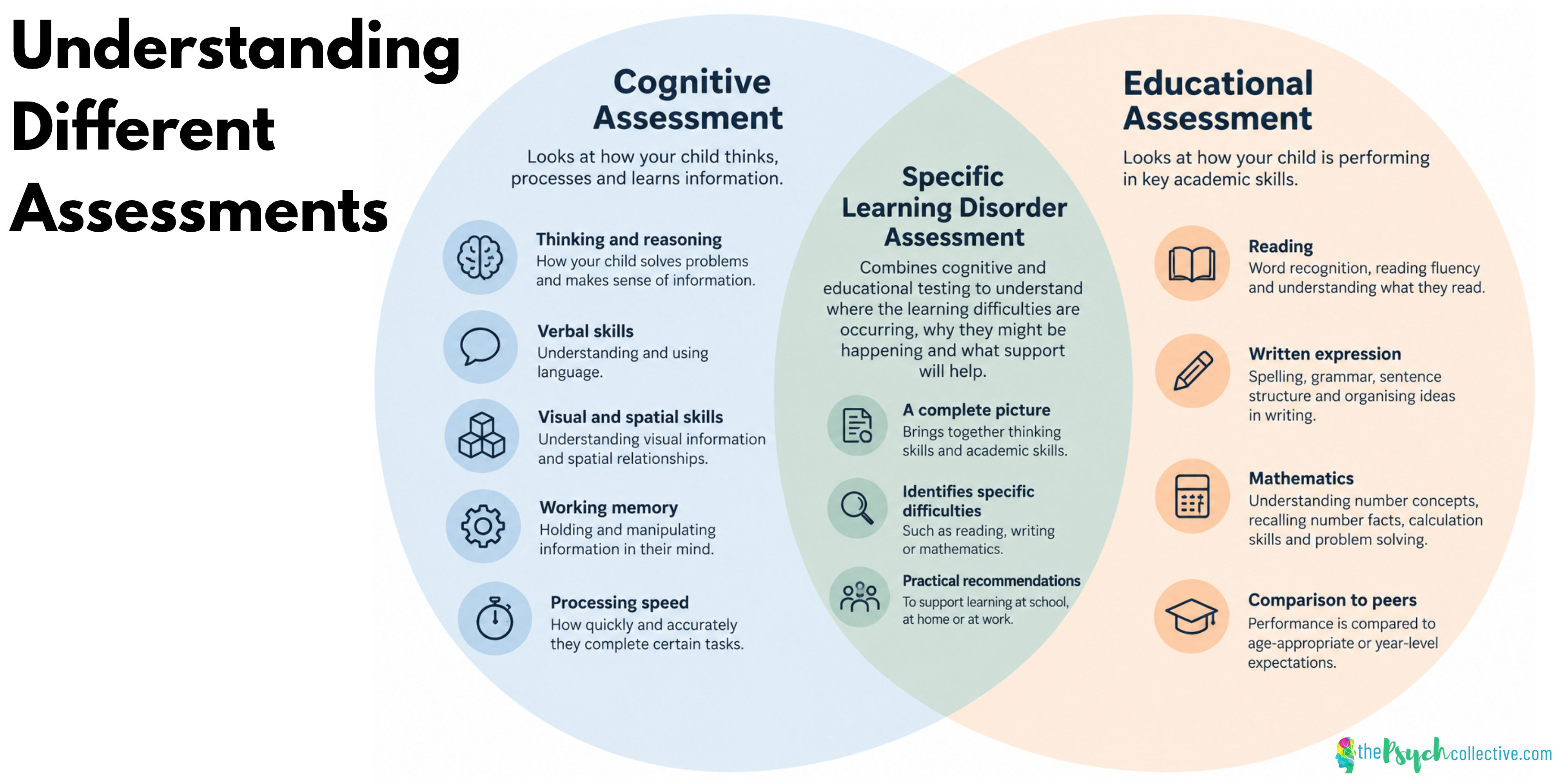
Although the terms are sometimes used interchangeably, they answer different questions.
|
Assessment |
What does it tell us? |
|---|---|
|
Cognitive assessment |
How does my child's brain process, remember and reason with information? |
|
Educational assessment |
How well is my child performing in reading, writing and maths compared with their peers? |
|
Specific Learning Disorder assessment |
Is there a persistent, identifiable learning difficulty, and what type of intervention is needed? |
What is a Cognitive Assessment?
A cognitive assessment examines a person's intellectual abilities and the different skills involved in learning and problem-solving.
At The Psych Collective, Peter uses standardised cognitive assessments such as the Wechsler Intelligence Scale for Children (WISC-V). Rather than simply producing an IQ score, the assessment examines several important areas:
-
Verbal comprehension: Understanding and using language.
-
Visual spatial ability: Understanding visual information and spatial relationships.
-
Fluid reasoning: Solving unfamiliar problems and recognising patterns.
-
Working memory: Holding and manipulating information in your mind.
-
Processing speed: How quickly and accurately you complete certain mental tasks.
These differences can significantly affect the classroom.
For example, a child might have perfectly adequate reasoning skills but relatively slow processing speed. They understand the lesson, but by the time they've processed the teacher's instructions, the rest of the class has already started working.
Another child might struggle with working memory. They understand each instruction individually but cannot hold all three instructions in mind long enough to complete the task.
Neither child is necessarily experiencing a Specific Learning Disorder, but their cognitive profile can help explain why learning feels more difficult and what accommodations might help.
What is an Educational Assessment?
An educational assessment measures a child's academic achievement in reading, writing, and mathematics and compares their performance with age-appropriate or year-level expectations.
Peter uses standardised achievement tests, such as the Woodcock-Johnson assessment, to identify specific strengths and difficulties.
Rather than simply telling us that a child is behind in reading, an educational assessment helps distinguish between problems recognising words, reading fluently and understanding written material.
This distinction matters because interventions for each difficulty can differ significantly.
What is a Specific Learning Disorder assessment?
A Specific Learning Disorder assessment investigates whether a child's academic difficulties are persistent, clinically significant and consistent with the diagnostic criteria for an SLD.
Peter generally combines cognitive and educational testing to develop a comprehensive understanding of the child's abilities. He also considers their developmental history, educational experiences, previous interventions and other possible explanations for their difficulties.
Importantly, diagnosing a learning disorder is no longer simply about identifying a large gap between a person's IQ and academic achievement. A child can have average, above-average or below-average cognitive abilities and still require careful investigation of their learning difficulties.
Is dyslexia still a diagnosis? What about dyscalculia and dysgraphia?
Yes, these terms are still used, but the DSM-5-TR uses the broader diagnosis of Specific Learning Disorder, with additional descriptions identifying whether the difficulty affects reading, written expression or mathematics.
The familiar terms haven't disappeared. Dyslexia, dyscalculia and dysgraphia remain widely recognised, particularly in educational settings. However, modern diagnostic terminology allows psychologists to identify the particular academic skills affected.
Dyslexia: Specific Learning Disorder with impairment in reading
Dyslexia generally refers to difficulties with accurate or fluent word recognition and spelling. Under the DSM-5-TR, a Specific Learning Disorder with impairment in reading can identify difficulties with:
-
Word reading accuracy.
-
Reading rate or fluency.
-
Reading comprehension.
Peter explains why this distinction is important. Some children can read individual words accurately but struggle to understand what they've read. Others understand language perfectly well but cannot recognise written words quickly or accurately.
Both children may have reading difficulties, but they require different approaches to intervention.
Dysgraphia: Specific Learning Disorder with impairment in written expression
Dysgraphia is a familiar term for writing difficulties, although its meaning can vary and may also encompass handwriting difficulties.
The DSM-5-TR diagnosis of Specific Learning Disorder with impairment in written expression identifies difficulties with spelling accuracy, grammar and punctuation, or the clarity and organisation of written expression.
For example, a child might have excellent ideas and communicate them beautifully in conversation but struggle to organise those ideas into written paragraphs.
Handwriting and fine-motor difficulties may require separate consideration, rather than automatically indicating an SLD.
Dyscalculia: Specific Learning Disorder with impairment in mathematics
Dyscalculia refers to difficulties understanding numbers and mathematical concepts. The DSM-5-TR identifies several areas of mathematical difficulty, including number sense, memorisation of arithmetic facts, calculation accuracy or fluency, and mathematical reasoning.
Peter gives the example of a child who can complete written calculations but struggles when those same calculations are presented as word problems.
Identifying the precise difficulty means educational support can target the skill that needs development, rather than simply giving the child more maths exercises.
Can my child be intelligent and still have a learning disorder?
Absolutely. A child can have average or above-average intelligence and still struggle significantly with reading, writing, or mathematics.
Intelligence and academic achievement are related, but they aren't the same thing.
Some children have strong verbal reasoning skills and can participate confidently in classroom discussions, yet struggle to translate their ideas into writing. Others develop sophisticated ways to compensate for their difficulties, so their learning disorder may not become obvious until academic demands increase.
This is one reason cognitive and educational testing can be so valuable. It helps us understand the child's individual learning profile, rather than making assumptions based on their grades or classroom behaviour.
Could it be ADHD rather than a learning disorder?
Yes. ADHD can interfere with learning through difficulties with attention, working memory, organisation and task completion. However, ADHD and Specific Learning Disorders can also occur together.
Consider a child who struggles to finish written assignments. Is it because they cannot spell and organise sentences, or because they become distracted and lose track of the task?
Perhaps it's both.
Peter explains that cognitive and educational assessments can identify areas of difficulty that may warrant further investigation. However, diagnosing ADHD requires its own assessment of symptoms, developmental history and functioning across different environments.
If attention and concentration are also concerns, read our article, "Is an ADHD Assessment Worth It?"
Does my child need six months of tutoring before getting diagnosed with a learning disorder?
A diagnosis of Specific Learning Disorder generally requires evidence that learning difficulties have persisted for at least six months despite targeted interventions. However, you don't necessarily need to wait six months before seeking an assessment.
Peter explains that psychologists need to establish that a child has had appropriate opportunities to learn the skill before concluding that a learning disorder is present.
For example, if a child is struggling with reading, we would want to know whether they have received targeted literacy instruction, such as MiniLit, MultiLit or other structured reading interventions. This doesn't necessarily mean six months of expensive private tutoring. Relevant support may include school-based literacy programmes, small-group interventions or individualised teaching.
Sometimes, particularly with younger children, an assessment identifies significant learning difficulties but there isn't yet sufficient evidence to confirm an SLD diagnosis. In these circumstances, Peter may recommend targeted intervention for six to twelve months, followed by a review of academic achievement. The original cognitive assessment may not need to be repeated. The benefit of early assessment is that parents and teachers can identify what needs attention and start providing the right support, even before a formal diagnosis is established.
What happens after a cognitive or educational assessment?
After the assessment, you receive a psychological report that explains the findings, identifies areas of strength and difficulty, and provides recommendations for support.
Peter places particular importance on making his reports understandable to parents, rather than filling them with psychological terminology. The report can help teachers and learning support teams understand what the child is experiencing and how to adjust their approach. For example, recommendations might include additional processing time, breaking instructions into smaller steps, targeted reading intervention or alternative ways of demonstrating knowledge.
A report can also support discussions about reasonable adjustments at school, university or in the workplace. Where relevant, it may contribute evidence to disability support applications, although a diagnosis or report does not automatically establish eligibility for NDIS funding.
Is a cognitive or educational assessment worth the money?
An assessment can be worthwhile when the results will clarify persistent difficulties and guide decisions about teaching, support or intervention. The real value isn't simply getting a diagnosis, but understanding what to do next. If your child has struggled for years, has repeatedly attended tutoring without improvement, or has become increasingly distressed about school, an assessment may help explain why.
Peter's approach is to identify not just whether a difficulty exists, but where it exists and what can be done about it.
Sometimes an assessment confirms a Specific Learning Disorder. Sometimes it identifies cognitive difficulties that the classroom can accommodate. Sometimes it helps rule out a suspected diagnosis and points to another explanation.
All of these outcomes can provide useful information.
Where should I start if I think my child needs an assessment?
You don't need to know whether your child needs a cognitive assessment, an educational assessment or a Specific Learning Disorder assessment before contacting us.
Start by explaining what you're noticing. What subjects are difficult? What have the teachers said? Has your child already received tutoring or learning support? Are they becoming frustrated, anxious or reluctant to attend school?
These details help determine the most appropriate assessment and whether we can incorporate any previous testing.
Psychological Assessments at The Psych Collective
At The Psych Collective, Registered Psychologist Peter Bland provides cognitive, educational and Specific Learning Disorder assessments for children, adolescents and adults.
Our aim is to provide more than a diagnostic label. We want you to understand the difficulties, recognise the person's strengths, and leave with practical recommendations you can use at school, at home, or in everyday life.
If you or your child is experiencing ongoing learning difficulties, we can help you determine the most appropriate assessment.
Learn more about our psychological assessment services and enquire about an appointment.
About Our Resources