Root Causes of Depression
Depression: Understanding the Root Causes and How to Address Them
Written by Dr Al Griskaitis, Consultant Psychiatrist and Jess O'Garr, Clinical Psychologist, for The Psych Collective
Depression is not simply a chemical imbalance or a condition that can always be resolved with medication. At The Psych Collective, we believe that depression is better understood by identifying the underlying problems that are causing emotional distress, understanding why that distress becomes prolonged, and developing practical solutions to address its root causes.
Depression is one of the most common mental health problems, yet the way we explain and treat it can sometimes be alarmingly low-resolution. You feel sad, exhausted, irritable and unmotivated. You see your doctor, receive a diagnosis of depression and perhaps a prescription for antidepressant medication.
But there is a question that can get overlooked in this process: Why are you depressed in the first place?
What in your life, your relationships, your health, your circumstances, or your thinking is making you feel this way? And why is it that some people recover from periods of sadness relatively quickly, while others become increasingly exhausted, sensitive and stuck?
These are the questions that led us to develop our own model of depression, which we explain in our book, The Depression Solution.
Our model begins with a different definition of depression.
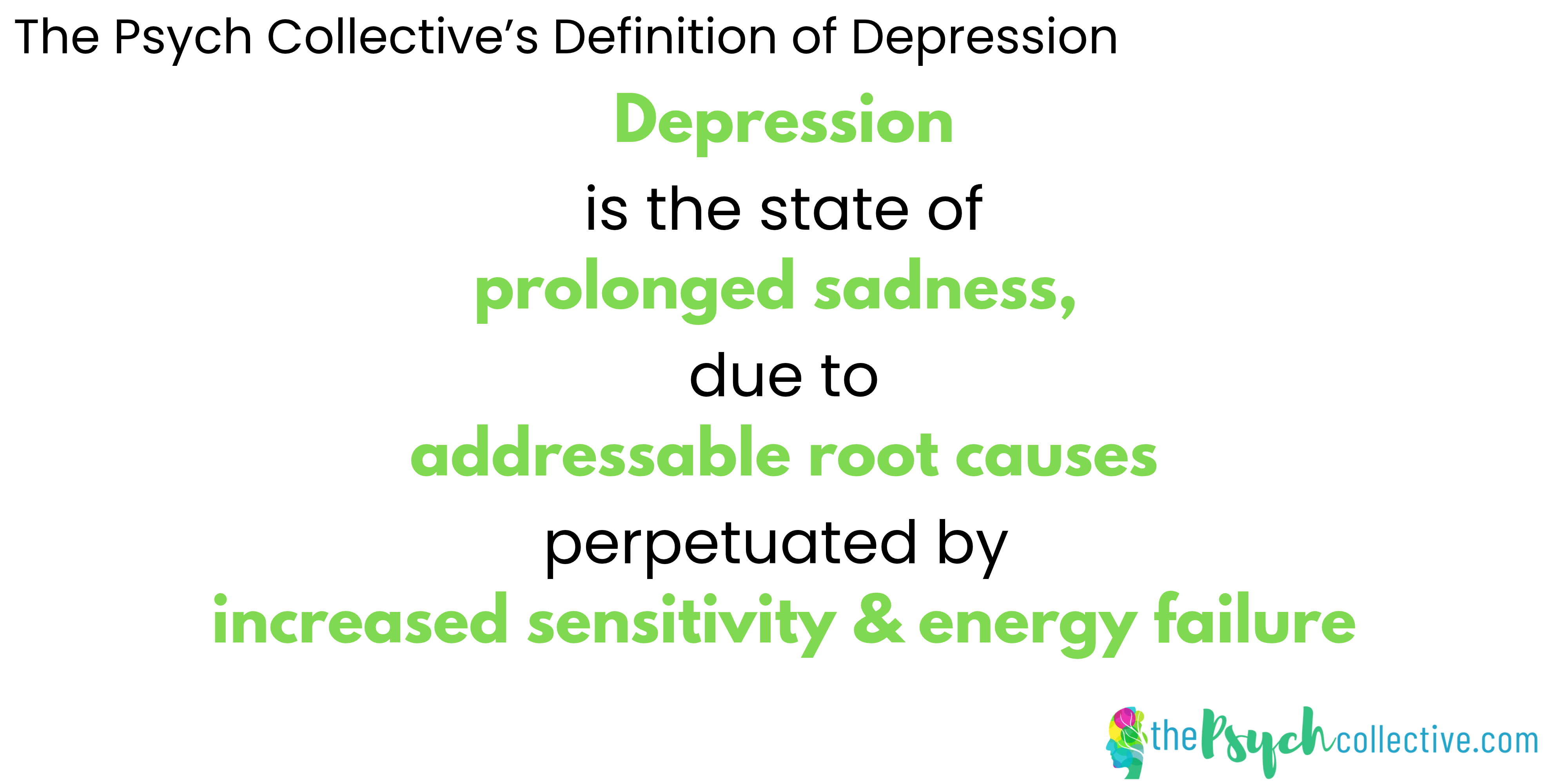
This definition underpins our approach. Rather than simply asking how we can reduce the symptoms of depression, we want to understand what is creating those symptoms and what can be done to change the circumstances maintaining them.
Is Depression Really Caused by a Chemical Imbalance?
For decades, depression has frequently been explained as a chemical imbalance in the brain, particularly a lack of serotonin. This explanation is appealing because it is simple: if you don't have enough serotonin, you become depressed, and antidepressant medication corrects the imbalance.
Unfortunately, the science is considerably more complicated.
Research has not established that depression is generally caused by a simple serotonin deficiency. Although serotonin is involved in mood regulation, depression cannot be reliably explained by measuring how much serotonin someone has.
This does not mean that brain chemistry is irrelevant or that antidepressants do not work. Antidepressant medications can be effective, particularly for some people experiencing moderate to severe depression. However, their benefits do not prove that depression was caused by a chemical deficiency.
We believe that the chemical imbalance explanation can also distract from something extremely important: the reasons a person is experiencing prolonged emotional distress.
Consider someone who is working in an exhausting job, struggling financially, experiencing relationship difficulties and barely sleeping. They become irritable, overwhelmed, sad and eventually lose the motivation to do anything.
Are they depressed because their serotonin is low? Or might their depression have something to do with the circumstances they are living in?
We would argue that those circumstances deserve serious attention.
Depression Is a Symptom of a Problem, Not Necessarily the Problem Itself
Dr Al Griskaitis often explains this using an old medical diagnosis called dropsy.
Hundreds of years ago, doctors used the term dropsy to describe people who developed swelling in their legs, abdomen or lungs. They could recognise the symptoms, but they didn't understand the underlying causes.
Eventually, doctors discovered that dropsy could result from several very different medical conditions, including heart failure, kidney disease and liver disease.
The swelling was real, but it wasn't the disease itself. It was a symptom of something else going wrong.
Interestingly, doctors also discovered that an extract from the foxglove plant helped some patients with dropsy. We now understand that foxglove contains digitalis-related compounds that can help with certain heart conditions. It worked for some patients because it addressed a particular underlying problem, but it wasn't a universal treatment for swelling.
We think depression can be understood in a similar way.
Two people might both experience sadness, low motivation, exhaustion and a loss of enjoyment. Yet the reasons they have become depressed could be completely different.
One person might be experiencing chronic loneliness. Another might be trapped in an unhappy relationship. Someone else might be exhausted from years of caring for others, while another might have lost their sense of purpose.
Of course, depression can also involve biological vulnerabilities, medical conditions and other factors that cannot be reduced to life circumstances alone.
The point is that identifying depression is only the beginning. We then need to understand what is driving it.
That is why we developed The Depression Solution: to help people move beyond recognising their symptoms and start identifying the problems they can actually address.
How Does Depression Develop? Understanding the Depression Pathway
Our model describes depression as a process that can develop when problems remain unresolved, negative emotions accumulate, sensitivity increases and emotional energy becomes depleted.
1. Root causes
Unmet needs, unresolved problems, difficult circumstances or other sources of distress
2. Negative emotions
Sadness, anger, fear, guilt, shame and frustration
3. Increased sensitivity
Everyday problems begin to feel bigger and harder to manage
4. Energy failure
Emotional fatigue, reduced enjoyment, exhaustion and loss of motivation
5. Prolonged depressed mood
Feeling increasingly overwhelmed, hopeless or trapped
The cycle feeds back on itself: reduced energy and motivation make problems harder to resolve, increasing distress and sensitivity.
This pathway is a conceptual model of how depression may develop and persist. It isn't intended to explain every presentation of clinical depression, but it gives us a useful framework for understanding why people can become stuck.
Let's break it down.
Step 1: Something Goes Wrong — The Root Causes of Depression
Negative emotions are a normal and necessary part of being human. They alert us when something important needs our attention. Sadness might tell us we have lost something valuable. Anger might indicate that someone has crossed a boundary. Fear alerts us to possible danger. Guilt might encourage us to repair a relationship.
These emotions are not necessarily symptoms of a mental health disorder. They are part of a system designed to motivate us to respond to problems. When we recognise a problem, take action and resolve it, our negative emotions will often settle. We might even experience positive emotions such as relief, satisfaction, pride or happiness.
But what happens when we cannot resolve the problem?
Perhaps the problem is outside our control. Perhaps we don't have the skills, resources or support to deal with it. Or perhaps we don't even understand what the problem is. The negative emotions persist, and additional problems may begin to accumulate.
Step 2: Negative Emotions Accumulate
Imagine you are having a particularly difficult week. Work is stressful, you've argued with your partner, the kids are demanding your attention, and you haven't been sleeping well. On your own, you might be able to cope with each of these problems. But when they all happen together, the emotional load starts to build. Instead of experiencing one negative emotion, dealing with the problem and moving on, you experience repeated episodes of sadness, anger, frustration, anxiety or disappointment.
And when those emotions keep coming without enough resolution or recovery, you become emotionally fatigued.
Step 3: Your Emotional Sensitivity Increases
One of the central ideas in our model is that the more sensitive you become, the more intensely you experience problems.
Think about a child knocking over a glass of milk. On a good day, when you're well rested and feeling reasonably happy, you might simply grab a cloth and clean it up. But imagine the same thing happens when you've had a terrible day, barely slept and are already overwhelmed. Suddenly, a spilt glass of milk feels like the final straw.
"Oh, for f*cks sake! Can nothing go right today?"
The problem hasn't changed. Your sensitivity to the problem has.
Sensitivity can be influenced by many factors, including sleep deprivation, stress, hunger, physical illness, alcohol, pain and prolonged emotional distress. When sensitivity is high, relatively minor problems can trigger disproportionately intense emotional reactions. This creates another difficulty. You now experience more negative emotions, not necessarily because more serious things are happening, but because your brain is detecting problems everywhere.
Your problem radar has become increasingly sensitive.
Step 4: Emotional Fatigue Leads to Energy Failure
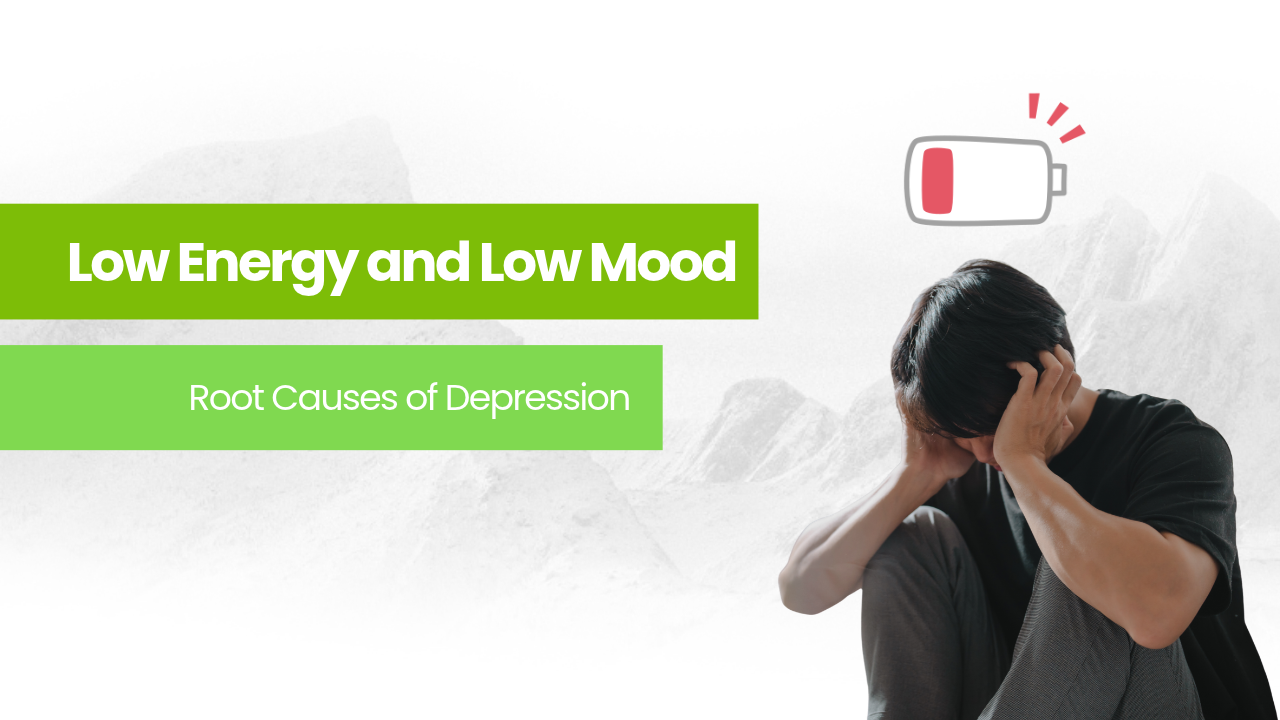
Experiencing negative emotions takes effort. When distress is prolonged, it can contribute to emotional exhaustion. We call this energy failure.
You might recognise it as:
-
Feeling exhausted even when you haven't done much physically.
-
Struggling to motivate yourself to complete everyday tasks.
-
Losing interest in activities you previously enjoyed.
-
Feeling overwhelmed by decisions or responsibilities.
-
Wanting to withdraw from people and activities.
-
Feeling like everything takes too much effort.
One of the particularly frustrating features of depression is that people often know what they should be doing but cannot find the energy to do it. You might know that exercise would help, that you need to deal with your finances or that seeing friends would probably make you feel better. But knowing what to do and having the energy to do it are two very different things.
This is why simply telling someone with depression to get out more, exercise or think positively can be spectacularly unhelpful. Low motivation is not necessarily laziness or a lack of willpower. It can result from emotional exhaustion.
For a more detailed explanation, read our companion article: How Low Mood Causes Low Energy and Motivation
Step 5: Depression Becomes a Self-Perpetuating Cycle
At this point, several things happen at once. Unresolved problems generate negative emotions. Your sensitivity is increased, so everyday difficulties feel more intense. You become emotionally exhausted, so you have less energy to resolve them. Because those problems remain unresolved, they keep generating negative emotions.
You can see how this becomes a cycle.
As motivation and enjoyment decline, opportunities for positive emotions may also decrease. The balance between positive and negative emotional experiences increasingly shifts toward the negative. Over time, you may begin to feel hopeless or trapped.
For some people, that sense of being trapped can become so distressing that thoughts of suicide emerge. Suicidal thoughts are an important signal of suffering and should always be taken seriously. They do not automatically mean someone intends to act on them, but they warrant direct assessment, support and an appropriate safety response.
The longer the cycle continues, the harder it can become to imagine a way out. But understanding the cycle also gives us an opportunity to interrupt it.
Understand your own depression pathway
Our book, The Depression Solution, explains the relationship between negative emotions, increased sensitivity and energy failure, before helping you work through the root causes that may be maintaining your depression. Explore the 108-page book and its practical approach to depression.
What Are the Root Causes of Depression?
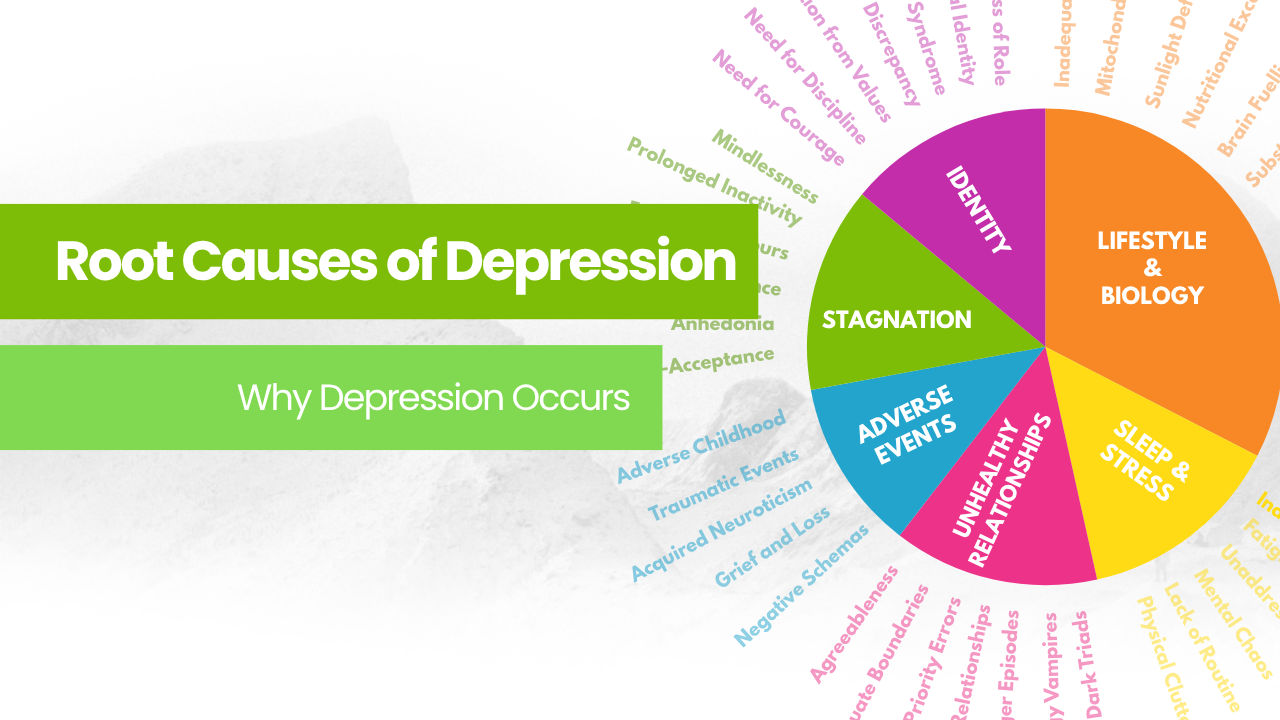
This is where we believe the most important work begins. Rather than treating depression as one single problem, we encourage people to investigate the different factors contributing to their emotional distress. Some common contributors include:
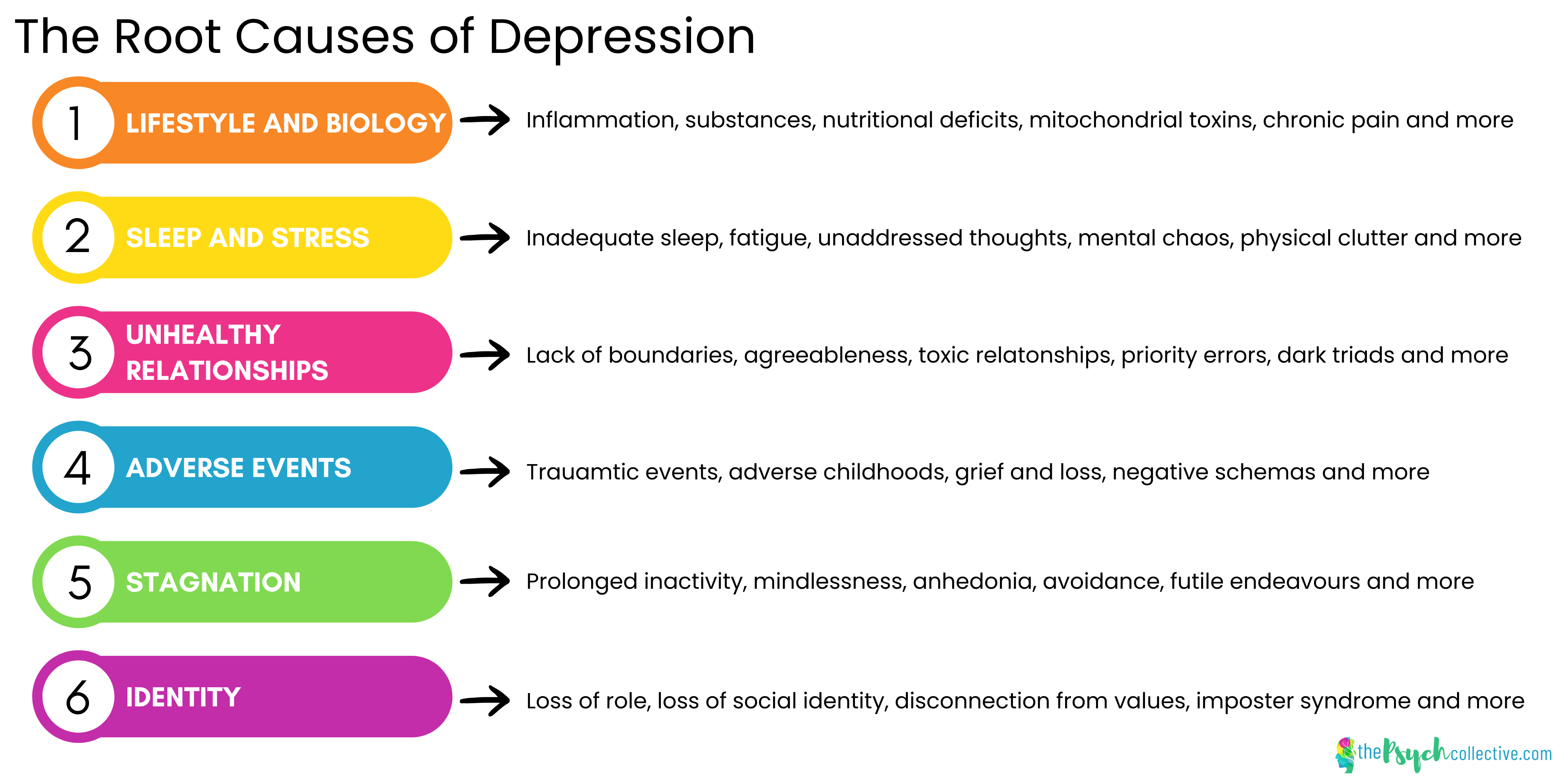
These factors can overlap, and not every contributor will be changeable. Some people experience depression without an obvious external trigger, while others have medical, biological or longstanding vulnerabilities that also need attention.
The goal is not to find one thing to blame. It is to develop a more sophisticated understanding of what is happening and identify realistic opportunities for improvement.
How Do You Identify and Address the Root Causes of Depression?
In our book, The Depression Solution, we've identified a range of potential root causes that can contribute to prolonged sadness and emotional distress.
Rather than simply providing a list of possible problems, we've broken each one down into four practical components:
-
The clues: How do you recognise whether this root cause might apply to you?
-
Why it's a problem: How does it contribute to negative emotions and maintain depression?
-
The potential solution: What would need to change to reduce its impact?
-
Actions to take: What can you actually do about it?
For example, one root cause we explore is what we call futile endeavours. This is when you repeatedly invest time, effort, and emotional energy into something that isn't getting you anywhere. You might feel as though you're working incredibly hard but achieving very little, or that your efforts are ultimately meaningless. You can probably imagine how frustrating and exhausting that might become. But recognising futile endeavours is only the beginning. Understanding why you keep doing it, what makes it so difficult to stop and how to change the pattern is where the real work happens. And that's what the book is designed to help you do.
Stop guessing why you're depressed. Start understanding what's keeping you stuck.
The Depression Solution is a 108-page practical guide that helps you investigate the potential root causes of your depression and identify actions you can take to address them.
Explore The Depression Solution ->Do Antidepressants Fix the Root Causes of Depression?
Not necessarily. And this is an important distinction.
Antidepressant medication can be effective in reducing depressive symptoms and improving functioning. In our model, we also consider how medication may help moderate emotional sensitivity, making difficult emotions feel more manageable.
For some people, that relief creates an opportunity to begin addressing the problems contributing to their depression. But medication cannot automatically resolve an unhappy relationship, change an overwhelming workload or give someone a sense of purpose. This doesn't mean antidepressants are unnecessary. They can be an important part of treatment, and some people benefit from taking them long term. Our point is that reducing symptoms and addressing the underlying causes are not necessarily the same thing.
We explore this distinction in greater detail in The Depression Solution, including the role of sensitivity, medication and the practical work involved in recovery.
Can You Recover From Depression?
Yes. Depression is treatable, and many people experience significant improvement or recovery. But there isn't one universal solution, because there isn't one universal cause. Some people benefit from psychological therapy, others from medication, and many from a combination of approaches. Addressing contributing problems, improving circumstances, and rebuilding meaningful activities can also play an important role.
Our approach looks beyond the diagnosis and asks a more useful question: What is keeping this particular person depressed, and what can we do about it?
The answer will be different for everyone.
And finding that answer is the purpose of The Depression Solution.
Watch the Video
This YouTube video features Dr Al Griskaitis explaining our root cause model of depression.
Frequently Asked Questions About Depression
What is the root cause of depression?
There is no single root cause of depression. Depression can develop through a combination of psychological, social, environmental, biological and medical factors. Our model focuses on identifying the specific contributors to a person's prolonged emotional distress, including unmet needs, unresolved problems, chronic stress and other circumstances that may be addressable.
Is depression caused by low serotonin?
Research does not support the simple explanation that depression is generally caused by a serotonin deficiency. Serotonin is involved in mood regulation, and antidepressants that affect serotonin can be helpful, but depression is considerably more complex than a single chemical imbalance.
Why does depression make you feel so tired?
Depression commonly causes fatigue, reduced motivation and difficulties with concentration. In our model, prolonged negative emotions and increased sensitivity contribute to emotional exhaustion and energy failure. Sleep disturbances, reduced activity and biological changes associated with depression can also contribute. Read more in our article about depression and low energy
Why do little things upset me so much when I'm depressed?
Depression can increase emotional reactivity and reduce your capacity to cope with everyday stress. When you are exhausted or overwhelmed, minor problems may feel significantly more difficult to manage. We describe this as increased sensitivity, which can contribute to the ongoing depression cycle.
Can unresolved problems cause depression?
Yes. Ongoing problems such as relationship conflict, chronic stress, loneliness, financial hardship and unmet emotional needs can contribute to depression. However, not everyone exposed to these circumstances becomes depressed, and depression can also occur without an identifiable external problem.
Can you recover from depression by fixing the root causes?
Addressing contributing problems can be an important part of recovery and may reduce the likelihood of ongoing distress. However, recovery is not always as simple as resolving one problem. Some people also need psychological therapy, medication, medical treatment, social support or other interventions.
What is the difference between sadness and depression?
Sadness is a normal emotion that usually occurs in response to something difficult or disappointing. Clinical depression involves a more persistent pattern of symptoms, often including low mood or loss of interest, changes in energy, sleep or appetite, difficulties concentrating and impaired functioning. Depression is not simply sadness that has lasted a long time.
Do I need antidepressants to overcome depression?
Not necessarily. Psychological therapies and other interventions can be effective treatments for depression. Antidepressants may also be helpful, depending on symptom severity, personal circumstances and treatment history. A qualified health professional can help determine the most appropriate approach.
Start Addressing the Causes, Not Just the Symptoms
Depression can make you feel as though something is fundamentally wrong with you. But often, there are understandable reasons why you are feeling overwhelmed, exhausted, unhappy or stuck.
Our model encourages you to become curious about those reasons rather than simply accepting that depression is something you have and must learn to live with.
Some causes may be straightforward to address. Others may be complicated, longstanding or partly outside your control. But developing a better understanding of what is maintaining your distress can help you make more informed decisions about your recovery.
You deserve more than an explanation of your symptoms. You deserve an opportunity to understand what is going wrong and what you can do about it.
If you are ready to explore the possible root causes of your depression, start with our book, The Depression Solution.
The Depression Solution
Understand your depression. Identify your root causes. Take practical action.
Learn about emotional sensitivity, energy failure and the factors that may be keeping you stuck, with practical strategies for making meaningful changes.
Explore The Depression Solution Available through The Psych Collective online store.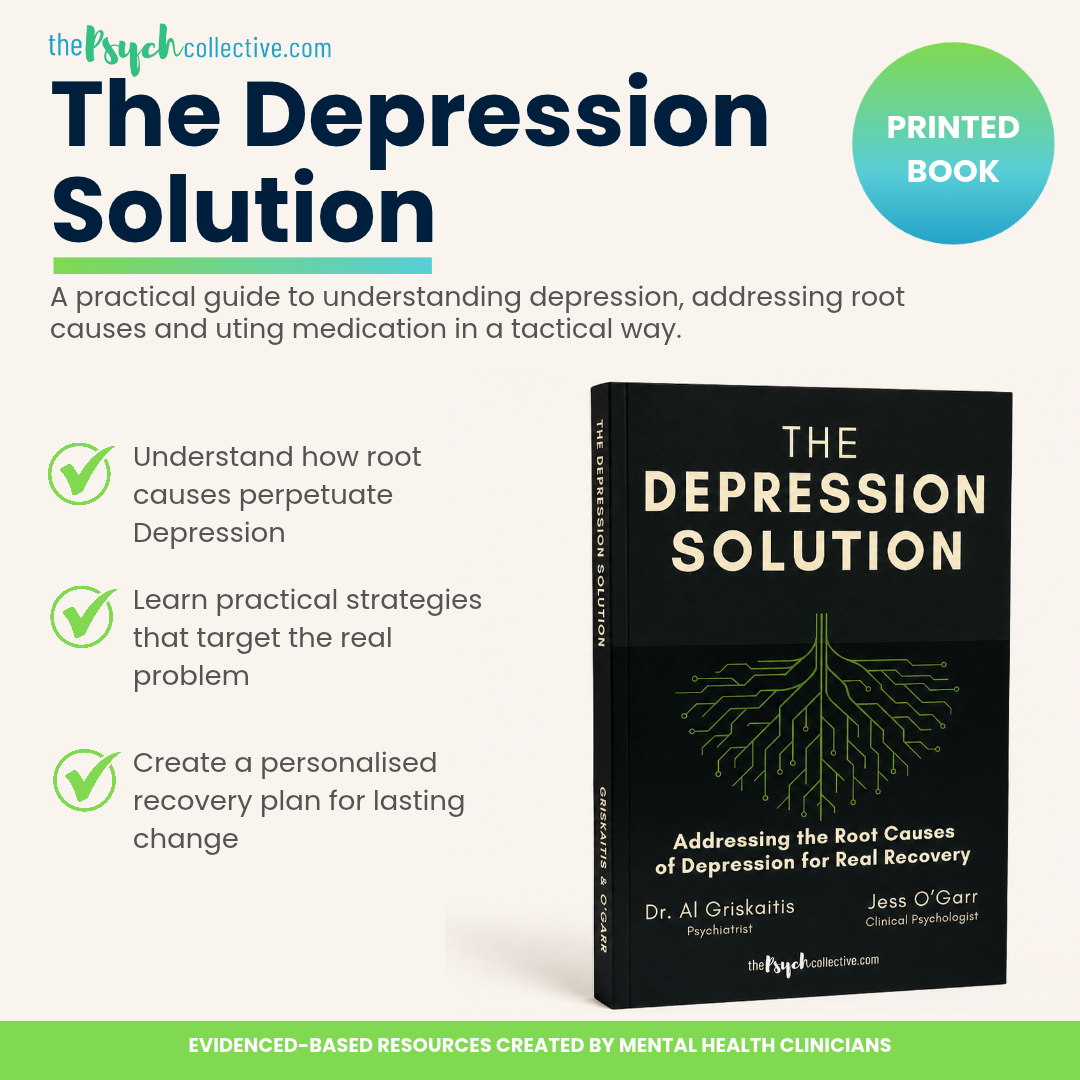
This article explains The Psych Collective's clinical model of depression. It is a conceptual framework rather than a universally established explanation of depressive disorders and does not replace individual assessment or evidence-based treatment. If you are experiencing suicidal thoughts, seek professional support promptly. In Australia, Lifeline is available on 13 11 14, and call 000 if there is immediate danger.
About Our Resources