How to Feel Your Feelings
How to Feel Your Feelings: LEAN In and Then RESPOND
“Feel your feelings.”
“Sit with the emotion.”
“Allow yourself to feel it.”
We tell people these things all the time. But there is a fairly obvious problem: what does it actually mean to feel your feelings?
If you have spent years suppressing your emotions, avoiding them or simply not having the words to describe them, being told to “sit with the feeling” isn't particularly useful. Sit with what? What are you supposed to notice? And once you've identified the emotion, what are you supposed to do with it?
At The Psych Collective, we use two skills to make this process much more practical: LEAN and RESPOND.
LEAN is the “what” skill: What am I feeling?
RESPOND is the “how” skill: How am I going to deal with this feeling?
The basic idea is simple: LEAN into your emotion first. Then RESPOND to it skilfully.
Why Do We Have Emotions?
Emotions aren't random inconveniences that we need to learn to switch off.
They have a function.
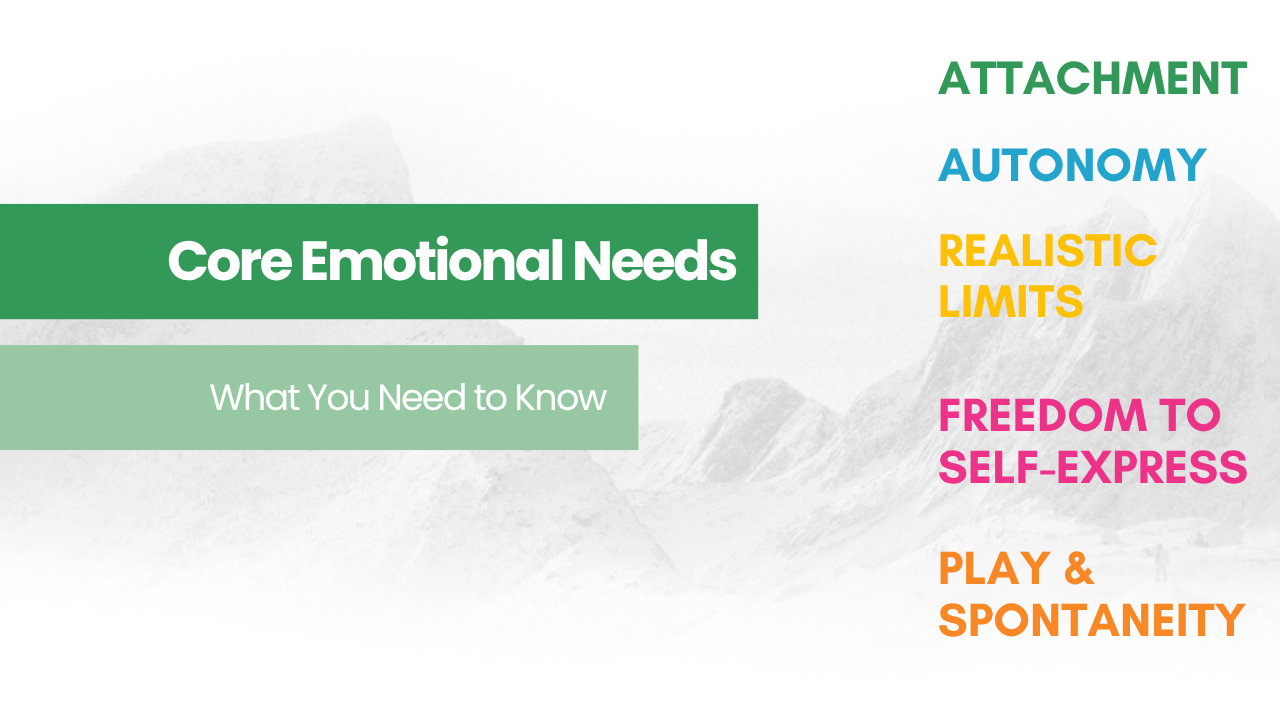
Human beings have needs. Some are biological: food, water, shelter and sleep. Most are emotional needs, such as connection, belonging, autonomy, growth, play, and safety.
When something happens that affects our ability to get our needs met, our brain makes an appraisal of what has happened. That appraisal generates an emotion, and the emotion helps motivate us towards some kind of action.
Anger tells us there is an obstacle in our way. Fear tells us there is danger. Sadness tells us that we have lost something important. Surprise alerts us that something unexpected has happened. Disgust helps us orient away from something potentially toxic or noxious. Joy tells us that things have gone well: keep doing what you're doing. DBT Canb- Emotions and LEAN
We explain this system in much more detail in our article on The 6 Basic Emotions. This article is about the next question:
Once an emotion shows up, what do you actually do with it?
First, LEAN Into Your Emotions
When people feel overwhelmed by their emotions, they may feel a strong urge to shut them down, detach from them, or ignore them completely.
The problem is that when you constantly avoid your emotions, you also lose the opportunity to learn about them. And without understanding your emotions, it is very difficult to regulate them effectively.
This is why we developed LEAN.
LEAN breaks an emotional experience into four things you can actually observe:
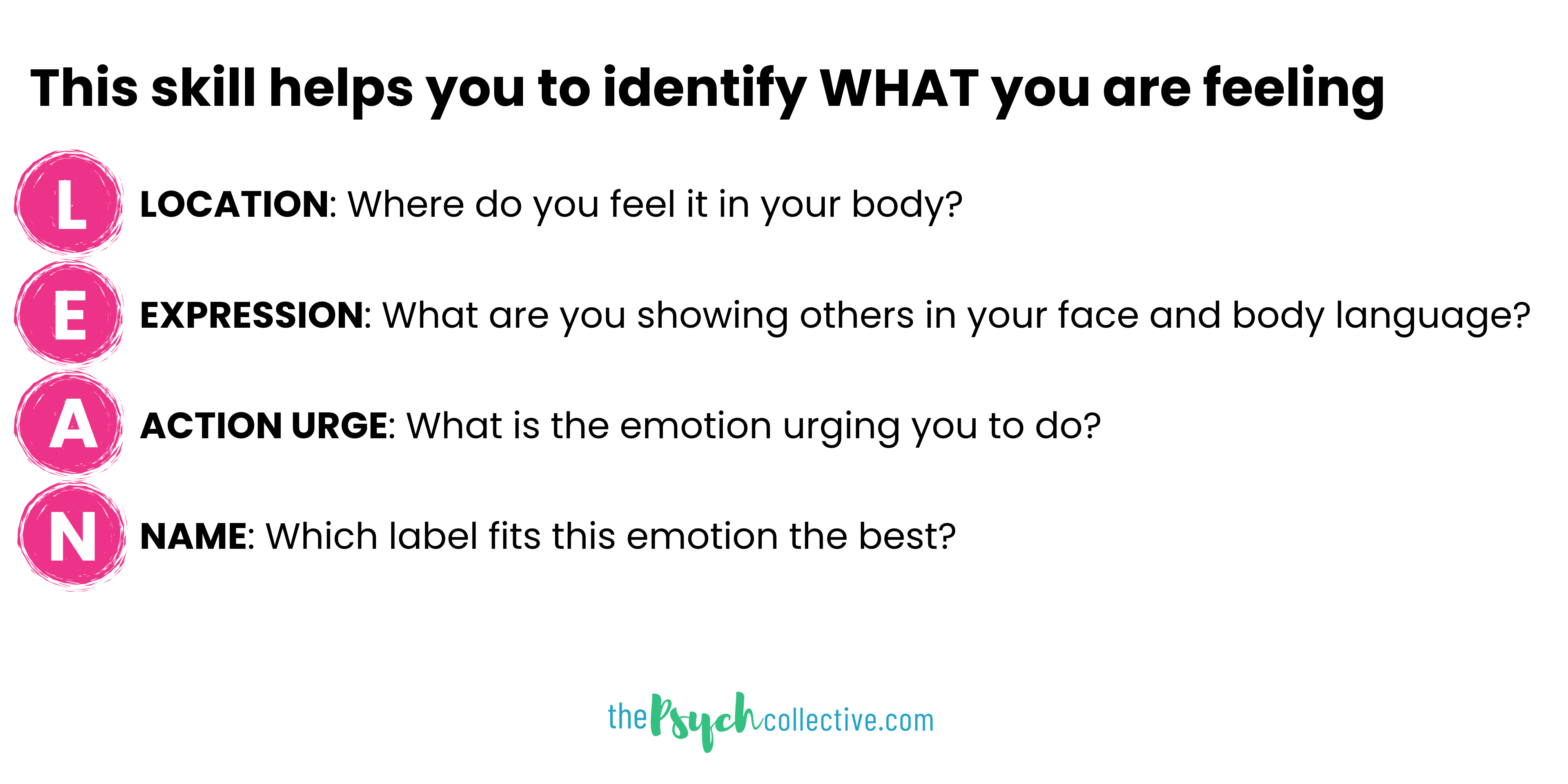
Rather than asking the enormous question, “How do I feel?”, LEAN gives you four much smaller questions to answer.
L — Location: Where Do You Feel the Emotion in Your Body?
Emotions are physical experiences.
Before you can even find the right word for an emotion, you may notice that something has changed in your body.
Where is it?
Anger might involve a clenched jaw, tight shoulders, heat in your face or tension in your fists. Fear might feel like butterflies or nausea in your stomach, a racing heart or tightness in your chest. Sadness might feel heavy, cold or hollow.
You don't have to experience emotions in exactly the same way as anybody else. The point is to start learning your own physical signs.
Ask yourself:
Where do I feel this in my body?
This can be particularly useful if you struggle to find words for your emotions. Your body may give you clues before you can name what is happening.
The LEAN worksheet deliberately starts with Location for this reason: emotions are felt in specific parts of the body, so the physical experience gives us one place to start investigating what we are feeling.
E — Expression: What Is Your Face and Body Communicating?
Emotions don't just happen inside us. They also change what we communicate to other people.
What is your face doing?
What is your posture doing?
Have your shoulders dropped? Are you avoiding eye contact? Have you crossed your arms? Are you frowning? Has your voice changed? Are you suddenly talking faster or louder?
These expressions serve an important social function. Emotions generate facial expressions and body postures that allow human beings to communicate non-verbally. EMOTIONS - LEAN worksheet
Sometimes everyone else can see our emotion before we've even realised we're having it.
So the second LEAN question is:
"What am I showing other people through my face and body language?"
A — Action Urge: What Is the Emotion Urging You to Do?
This is one of the most useful things to understand about emotions.
Emotions motivate action.
Anger can create an urge to confront, argue, fix the problem or overcome an obstacle.
Fear can create an urge to run, escape or avoid.
Sadness may make you want to withdraw, although ideally it can also move you towards seeking comfort and connection.
Surprise makes you stop and orient towards what has happened. Disgust makes you momentarily orient away.
Ask:
"What is this emotion urging me to do right now?"
Importantly, an action urge isn't an instruction.
Feeling an urge to yell doesn't mean you have to yell. Feeling an urge to send an angry text doesn't mean you should send it. Feeling an urge to cancel something because you are anxious doesn't necessarily mean cancellation is the best response.
There is a difference between:
“My emotion is urging me to do this.”
and
“I have decided this is the most skilful thing to do.”
That distinction becomes particularly important when we get to RESPOND.
N — Name and Nuance: What Exactly Are You Feeling?
Finally, we need to name the emotion.
Some people find this surprisingly difficult. Alexithymia is the term used to describe difficulty identifying and describing emotions, and one of the things people can lack is simply the vocabulary to put their internal experience into words.
You might start with:
I feel bad.
Then get to:
I feel angry.
That's useful. But can we get more precise?
Are you frustrated, annoyed, impatient, aggravated, resentful, furious or vengeful?
This is what we mean by nuance.
The basic six emotions give us useful broad categories, but there are many different words within those categories. The more precisely you can describe your experience, the easier it becomes to understand what is going on.
For example, frustration and annoyance might sound similar, but we often use frustration when the problem is task-focused and annoyance when it is person-focused. Similarly, jealousy and envy are frequently confused: jealousy is relational, while envy involves wanting something somebody else has.
You don't need to become a walking thesaurus. You are trying to move from:
I feel crap.
to:
I feel angry.
to:
Actually, I think I'm disappointed, embarrassed and a little bit resentful.
That gives you much more information to work with.
Build Your Emotional Vocabulary With Feeling Cards
If finding the N — Name and Nuance part of LEAN is difficult, having the words in front of you can make a huge difference.
Our Feeling Cards for Kids were designed to build emotional awareness and vocabulary rather than simply showing a feeling face. The cards help children identify, understand and express different feelings, and include practical information about how the feeling may show up and what they can do with it.
They can be used at home, in schools, or in therapy to move beyond happy, sad, and angry and build a richer emotional vocabulary.
Once You've LEANed In, You Need to RESPOND
LEAN helps you identify the emotion.
But identifying your feelings isn't the end goal.
Once you know what is happening, the next question is:
What am I going to do about it?
This is where we use RESPOND.
RESPOND is another Psych Collective acronym designed to help you work out what to do with an emotion so that you don't simply feel overwhelmed and helpless. EMOTIONS - RESPOND to your Emo…
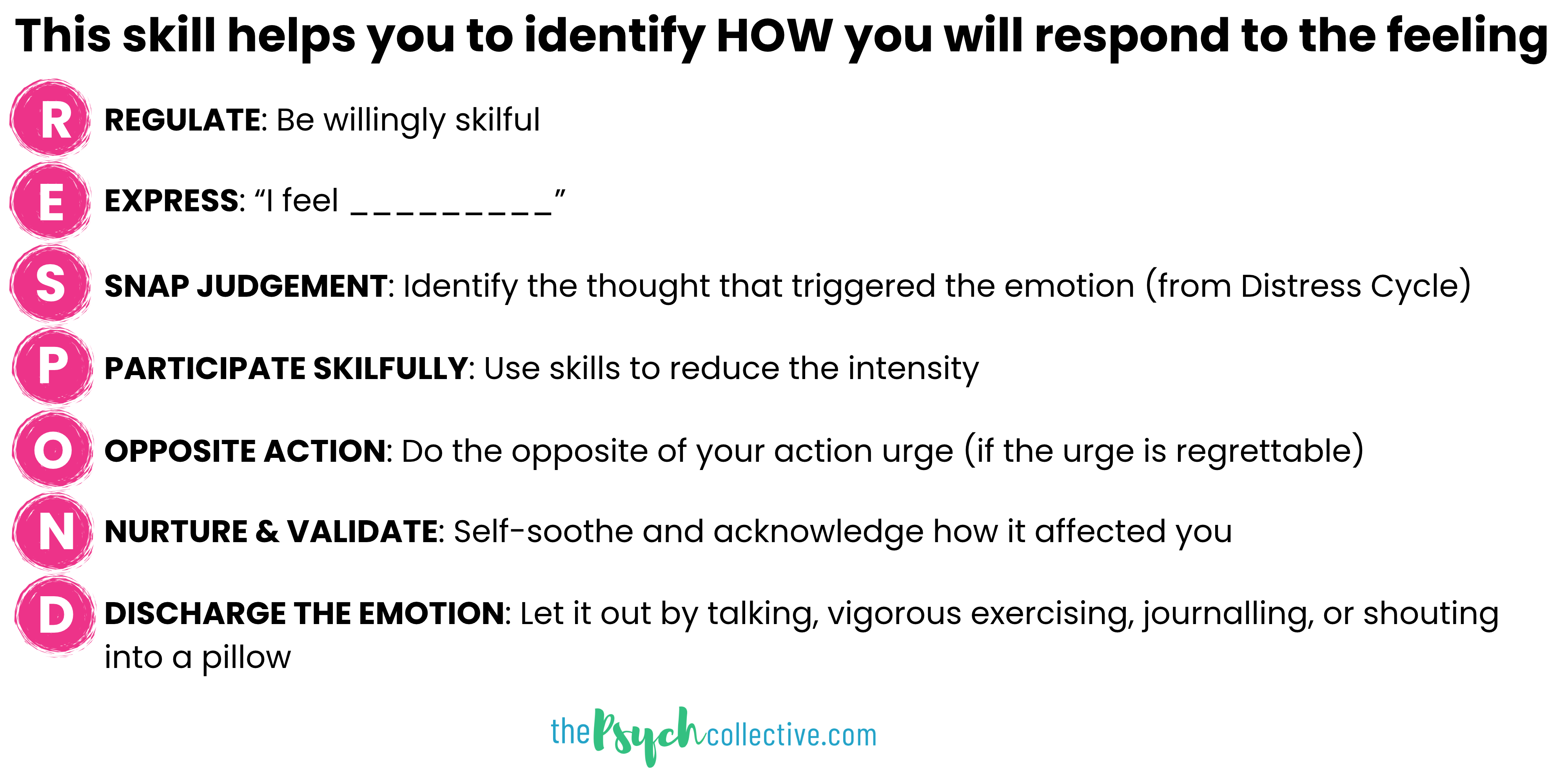
R — Regulate: Make the Choice to Be Skilful
The first step is a choice.
Be willingly skilful.
Before you decide how you're going to regulate the emotion, you have to decide that you are willing to try.
This can involve saying something to yourself such as:
"I'm really angry, AND I don't want to make this worse." (See the dialectic there?)
"I'm overwhelmed right now. I'm going to give myself a few minutes before I respond."
"Every part of me wants to avoid this, AND I know avoidance isn't going to help me in the long term."
The RESPOND worksheet asks a useful question:
What do you need to say to yourself to commit to being skilful?
You aren't choosing whether or not to have the emotion. It is already there.
You're choosing what happens next.
E — Express: “I Feel ______”
Now put the feeling into words.
"I feel angry."
"I feel embarrassed."
"I feel disappointed."
Ideally, you may be able to say this to another person. If nobody is available (or the people around you aren't safe people to share your feelings with), saying it to yourself can still be valuable.
Expressing an emotion doesn't mean dumping it onto somebody else.
“I feel angry” is different from screaming at someone.
“I feel hurt” is different from attacking the person who hurt you.
The goal is to express the emotion rather than act it out.
S — Snap Judgement: What Thought Sparked the Emotion?
There is usually an appraisal or judgement sitting underneath an emotion.
Something happens, and your brain very quickly decides what it means.
"This isn't fair."
"They don't care about me."
"I'm going to fail."
"I'm going to be rejected."
In our Distress Cycle, we refer to this as the snap judgement.
RESPOND asks you to identify the thought or appraisal that sparked the emotion.
You don't have to immediately argue with the thought. Start by noticing it.
What happened, and what did my brain decide that meant?
Once you can see the snap judgement, you have something you can work with rather than simply being swept along by the resulting feeling.
P — Participate Skilfully: What Skill Do You Need?
Now we get practical.
Which skill could reduce the intensity of this emotion enough for you to deal with the situation effectively?
Maybe you need to slow your breathing.
Maybe you need grounding.
Maybe you need to check the facts.
Maybe you need to leave the situation temporarily and come back when your arousal has reduced.
Maybe you need to communicate a boundary.
Maybe you need a distress-tolerance skill to get you through the next ten minutes without doing something that will make the situation worse.
There isn't one magical emotion-regulation skill that works every time.
The aim is to build a sufficiently broad toolkit that you can choose a skill that fits this emotion, at this intensity, in this situation.
O — Opposite Action: Should You Do the Opposite of Your Urge?
Go back to the A in LEAN.
What was your action urge?
Now ask:
If I follow that urge, am I likely to regret what happens next?
If the answer is yes, consider opposite action.
If anger is telling you to send a furious message immediately, opposite action might involve putting the phone down and waiting.
If shame is telling you to hide from everyone, opposite action might involve contacting somebody safe.
If anxiety is telling you to avoid something that is actually safe, opposite action might involve gradually approaching it instead.
The RESPOND worksheet puts it simply: if your urge would lead to regrettable actions, what is the opposite action?
This is why LEAN and RESPOND work together.
You can't make a thoughtful decision about your urge if you haven't noticed it in the first place.
N — Nurture and Validate: Look After the Feeling
Not every emotion needs to be challenged or fixed.
Sometimes you need to acknowledge:
"Of course I'm sad. I lost something important."
"Of course I'm angry. That really wasn't okay."
"Of course I'm scared. That was frightening."
Validation doesn't mean that every thought you have is factually correct or that every behaviour is justified.
It means acknowledging that the emotion is there and something affected you.
Then ask: "What would help me look after myself while I'm feeling this?"
This might involve self-soothing, seeking support, giving yourself some time to recover, or simply speaking to yourself with the same compassion you would offer somebody else.
RESPOND deliberately combines nurture and validate: self-soothe while also acknowledging how the experience affected you.
D — Discharge the Emotion: Does the Feeling Need Somewhere to Go?
Some emotions carry a lot of physiological energy.
This is particularly obvious with emotions such as anger and fear.
You can understand exactly why you're angry. You can decide not to act on the urge. You can check your thinking.
And your body can still be absolutely buzzing.
Sometimes that energy needs to go somewhere.
Discharging an emotion means finding a safe way to release some of that activation. Our RESPOND worksheet suggests strategies such as talking, vigorous exercise, journalling or shouting into a pillow.
Discharging anger isn't permission to become aggressive towards another person. It is about recognising that emotions are physiological as well as psychological and giving that activation an appropriate outlet.
Putting LEAN and RESPOND Together
Imagine you have just had an interaction with someone and you can feel yourself getting worked up.
Instead of immediately reacting, start with LEAN.
Location: "My jaw is tight and my shoulders are tense."
Expression: "I'm frowning, my arms are crossed and my voice is getting louder."
Action urge: "I want to argue with them and send a message telling them exactly what I think."
Name and nuance: I'm angry — but more specifically, I feel annoyed, dismissed and resentful."
Now you can RESPOND.
Regulate: "I'm angry, AND I don't want to make this situation worse."
Express: "I feel really dismissed by what just happened."
Snap judgement: "They don't respect me."
Participate skilfully: Take some time to reduce the intensity and check the facts before responding.
Opposite action: Don't send the message while angry.
Nurture and validate: "It makes sense that being dismissed has upset me."
Discharge: Go for a brisk walk and talk it through with someone safe.
That's very different from simply being told to “sit with your anger.”
It gives you something to actually do.
Download the LEAN and RESPOND Worksheets
Knowing an acronym and being able to use it when you're emotional are two different things. These skills become easier with practice.
The LEAN Into Your Emotions worksheet helps you practise identifying the Location, Expression, Action Urge and Name of the six basic emotions before applying the skill to your own emotional experiences.
The RESPOND to Your Emotions worksheet then helps you work through Regulate, Express, Snap Judgement, Participate Skilfully, Opposite Action, Nurture and Validate, and Discharge so you can plan how you want to deal with different emotions in the future.
Download the LEAN Into Your Emotions Worksheet →
Download the RESPOND to Your Emotions Worksheet →
Practise when you're relatively calm. The more familiar the steps become, the easier they are to access when you're actually emotional.
You Don't Need to Get Rid of Your Feelings
Emotional regulation doesn't mean learning how to stop feeling.
And it doesn't mean blindly acting on everything you feel.
It means getting better at having emotions.
And if the hardest part is finding the words for what you feel, start by building your emotional vocabulary. Our Feeling Cards for Kids provide a practical way for children, parents, teachers and clinicians to identify and talk about a much broader range of feelings — and, importantly, what to do with them. EMOTIONS - LEAN worksheet
Are you a Clinician?
We teach this piece of the function of emotions and emotion regulation skills in our DBT and Beyond workshop.
Check out the workshop for more information.
About Our Resources