ADHD vs Autism: What's the Difference, and Can You Have Both?
Written by Jess O'Garr, Clinical Psychologist, in consultation with Peter Bland, Registered Psychologist at The Psych Collective.
ADHD and autism are two distinct neurodevelopmental conditions, but they share several characteristics and frequently occur together. Difficulties with attention, social interactions, emotional regulation, sensory sensitivities and everyday functioning can be associated with either condition. So how do you tell the difference between ADHD and autism, what does AuDHD mean, and when is a combined assessment worthwhile?
Understanding the difference between ADHD and autism isn't always straightforward. Someone might struggle in social situations because they find it hard to interpret social cues, get distracted and lose track of conversations, or both. Similarly, someone might crave novelty and stimulation but become distressed when their routine changes. These apparently contradictory experiences can make more sense when we understand how ADHD and autism interact.
However, it's important not to assume that having overlapping characteristics automatically means someone has either condition. Many of these experiences also occur in people without ADHD or autism, particularly when they're experiencing anxiety, stress or emotional exhaustion. An assessment aims to understand why someone is experiencing difficulties, whether they meet diagnostic criteria, and what support might actually help.
What is the difference between ADHD and autism?
The main difference between ADHD and autism lies in their core diagnostic characteristics. ADHD involves persistent difficulties with attention regulation and/or hyperactivity and impulsivity, whereas autism involves differences in social communication and interaction, alongside restricted or repetitive patterns of behaviour, interests or activities.
Both are neurodevelopmental conditions, meaning their characteristics begin during development, although they may not be recognised until adolescence or adulthood. Both can affect how someone manages relationships, education, employment, and everyday responsibilities, but the underlying causes can differ.
ADHD is primarily associated with difficulties regulating attention, activity levels and impulses. Someone with ADHD might struggle to organise tasks, sustain concentration, remember responsibilities or resist distractions. Autism, on the other hand, involves differences in social communication and interaction, along with characteristics such as a preference for predictability, focused interests, repetitive behaviours, or sensory differences.
The distinction becomes more complicated in everyday behaviour. Both an autistic person and someone with ADHD might find conversations exhausting, struggle with emotional regulation or experience difficulties adapting to change. That is why clinicians need to look beyond the behaviour itself and investigate what contributes to it.
ADHD vs Autism: How do the symptoms compare?
Although ADHD and autism have different diagnostic criteria, some characteristics can appear similar in everyday life. The following table highlights some common differences, although individual experiences vary considerably.
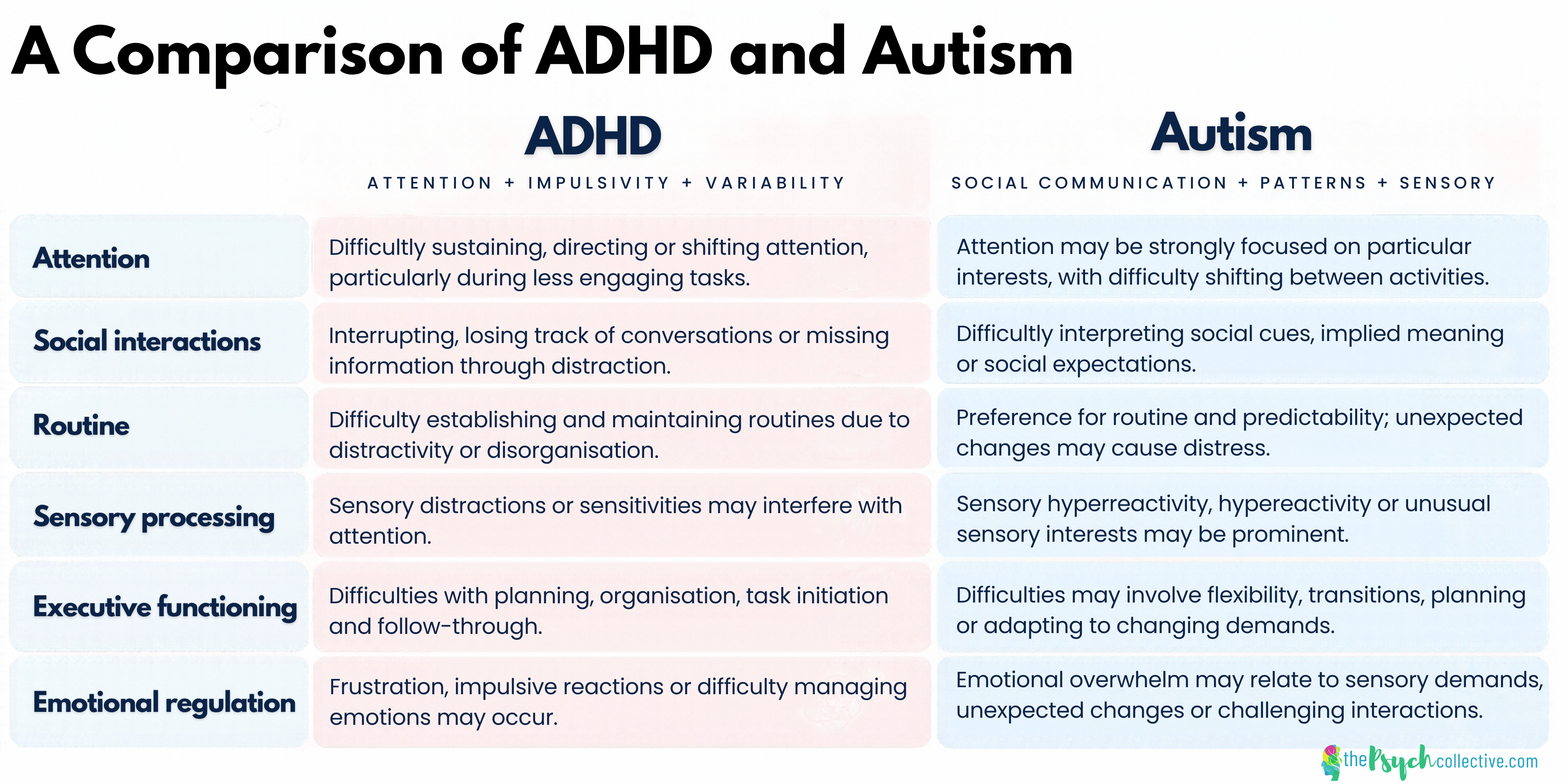
These differences are not absolute, and you can't identify either condition from a comparison table alone. Executive functioning difficulties, emotional overwhelm and sensory sensitivities can occur in both conditions, but they are also associated with anxiety, depression, trauma, sleep difficulties and prolonged stress. What matters is the broader pattern of characteristics, their developmental history, and their impact on the person's functioning.
Can you have both ADHD and autism?
Yes. ADHD and autism can occur together, and research indicates that they share some genetic and neurodevelopmental influences. When someone independently meets the diagnostic criteria for both conditions, they can receive both diagnoses.
Historically, ADHD and autism were often considered separately, and earlier diagnostic systems restricted clinicians from diagnosing both conditions in the same person. This changed with the DSM-5 in 2013, which recognised that ADHD and autism can coexist. Research has since continued to show considerable overlap between the conditions, although the degree of overlap varies by population and assessment methods.
Having ADHD doesn't automatically mean someone is autistic, and having autism doesn't mean someone also has ADHD. Some shared characteristics may arise from one condition, both conditions or another explanation entirely. A comprehensive assessment therefore needs to establish whether the person meets the criteria for each diagnosis independently, rather than assuming that overlapping symptoms indicate two disorders.
What is AuDHD, and what does it look like in adults?
AuDHD is an informal term used to describe someone who has both autism and ADHD. It isn't a separate clinical diagnosis, but it can be a useful way of describing the interaction between the two conditions.
For some adults, AuDHD helps explain experiences that don't seem to fit neatly into either ADHD or autism alone. They might seek novelty, stimulation and spontaneous experiences while simultaneously needing structure and predictability. Alternatively, they may find routines reassuring but struggle to establish or maintain them because of difficulties with organisation, attention or remembering tasks.
These competing needs can be particularly frustrating. Someone might carefully plan their week because knowing what to expect helps them feel settled, only to find that they repeatedly forget appointments, become distracted or struggle to follow their own schedule. They may then become distressed when their carefully planned routine falls apart, even though maintaining that routine was difficult in the first place.
Social interactions can also become complicated when both conditions are present. Someone might enjoy meeting new people and have plenty to say, but struggle to interpret subtle social expectations while also interrupting or losing track of conversations. Recognising each condition's contribution can help explain these experiences and guide more appropriate strategies. However, contradictory needs or difficulties with routine are not, by themselves, evidence of AuDHD.
Why are ADHD and autism often confused?
ADHD and autism are sometimes confused because the same observable behaviour can have different underlying causes. A person may appear distracted, socially uncomfortable, or emotionally overwhelmed, but understanding why they experience these difficulties is essential.
Social communication provides a useful example. An autistic person may find conversations difficult because interpreting facial expressions, implied meaning or unspoken social expectations requires considerable effort. Someone with ADHD may understand these social cues but miss information because their attention wanders, they interrupt impulsively or they lose track of what the other person is saying.
From the outside, both people might appear to struggle with social interaction. However, the underlying difficulties differ, so the most useful supports may also differ. The autistic person might benefit from clearer communication and reduced ambiguity, while the person with ADHD might benefit from strategies that support attention and conversational turn-taking.
When both conditions are present, these experiences can interact, making the presentation more complex. This is one reason why a comprehensive psychological assessment should investigate the mechanisms behind someone's difficulties rather than simply counting symptoms on a questionnaire.
Is sensory sensitivity a sign of autism or ADHD?
Sensory sensitivities can occur in both ADHD and autism, but sensory differences have a more established role in the diagnostic criteria for autism. They are not, however, sufficient to diagnose either condition.
Someone might find loud environments overwhelming, become distracted by background conversations, dislike particular clothing textures or experience discomfort under bright lighting. In autism, sensory hyperreactivity, hyporeactivity or unusual sensory interests may form part of the broader pattern of restricted or repetitive behaviours and interests. People with ADHD can also report sensory sensitivities, particularly when competing sensory information interferes with their ability to concentrate.
Importantly, sensory sensitivity is not exclusive to neurodevelopmental conditions. Anxiety, stress, migraine and other health conditions can also influence sensory experiences. A clinician therefore needs to consider how these sensitivities relate to the person's broader developmental and behavioural profile rather than treating them as standalone evidence of autism or ADHD.
Can ADHD and autism be diagnosed in adulthood?
Yes. Both ADHD and autism can be identified in adulthood, provided the assessment establishes that the relevant developmental characteristics were present earlier in life. A diagnosis may be made later even when the underlying condition has been present since childhood.
Some people reach adulthood without recognising that their longstanding difficulties may relate to a neurodevelopmental condition. They may have developed effective coping strategies, received substantial support from family members or attended schools and workplaces where their difficulties were less apparent. Others may have learned to mask particular characteristics, making them less obvious to the people around them.
Masking involves modifying behaviour to meet social expectations or reduce the visibility of difficulties. For example, someone might rehearse conversations, imitate other people's social behaviour or put considerable effort into appearing organised and attentive. Although these strategies can help someone navigate particular situations, they may require substantial effort and contribute to exhaustion.
However, masking and compensation are not exclusive to ADHD or autism. People experiencing anxiety or other psychological difficulties may also modify their behaviour to manage social expectations. A clinician must therefore examine the person's developmental history, the nature of their difficulties and whether these experiences are consistent with the diagnostic criteria.
What's the difference between an ADHD assessment and an autism assessment?
An ADHD assessment focuses primarily on attention, hyperactivity, impulsivity and their impact on functioning, whereas an autism assessment examines social communication and interaction alongside restricted or repetitive behaviours, interests and sensory characteristics.
Although both assessments examine developmental history and everyday functioning, they focus on different areas and may use different tools. An ADHD assessment typically includes a detailed clinical interview, information about childhood development, an examination of symptoms across different settings and consideration of other possible explanations. Clinicians may use structured interviews such as the DIVA for adults or Young DIVA for children, alongside questionnaires and information from parents, partners, or teachers.
An autism assessment also examines developmental history but places greater emphasis on social communication, interaction, patterns of behaviour, focused interests and sensory experiences. Depending on the person's age and circumstances, clinicians may use tools such as the Autism Diagnostic Observation Schedule, Second Edition (ADOS-2), and the Autism Diagnostic Interview–Revised (ADI-R). The ADOS-2 uses structured activities and interactions that let the clinician observe communication and behaviour, while the ADI-R is a detailed developmental interview, usually conducted with someone who knows the person's early history well.
Neither tool alone determines a diagnosis. Results must be interpreted alongside the clinical interview, developmental information and diagnostic criteria. As assessment psychologist Peter Bland explains, understanding a person's developmental history is particularly important when distinguishing between overlapping neurodevelopmental characteristics, especially when someone has developed compensatory strategies that make their difficulties less apparent.
Should you get assessed for ADHD and autism together?
A combined ADHD and autism assessment may be worthwhile when someone has significant characteristics associated with both conditions, or when assessing only one condition could leave important difficulties unexplained.
For example, someone seeking an ADHD assessment might describe longstanding attention and organisational difficulties alongside sensory sensitivities, social communication differences and a strong need for predictability. Alternatively, someone seeking an autism assessment might also report substantial impulsivity, distractibility and difficulty regulating attention. In these circumstances, investigating both conditions may provide a more complete understanding of the person's experiences.
A combined assessment allows the clinician to differentiate overlapping characteristics, determine whether the diagnostic criteria for ADHD, autism, both, or neither are met, and explore alternative explanations. It can also identify masking, compensatory strategies and co-occurring difficulties such as anxiety, depression, learning disorders or sleep problems. This is particularly valuable when someone's presentation doesn't fit neatly within a single diagnostic framework.
However, not everyone seeking an ADHD assessment needs an autism assessment, and vice versa. The appropriate pathway should be guided by the person's history, presenting concerns and clinical indications. Recommend a combined assessment only when there is a genuine reason to investigate both conditions, not simply because they frequently occur together.
What are the benefits of a combined ADHD and autism assessment?
The main benefit of a combined assessment is a more complete understanding of the person, especially when one condition alone cannot adequately explain their difficulties.
A combined assessment can help clarify how attention regulation, executive functioning, social communication, sensory processing and emotional regulation interact. Rather than considering each difficulty separately, the clinician can examine how different characteristics influence one another and contribute to the person's overall functioning.
This is important because a strategy that helps with one difficulty might create challenges elsewhere. For example, adding structure may support ADHD-related organisational difficulties, but it needs to be realistic and achievable. Similarly, increasing novelty or stimulation may help someone stay engaged, but excessive unpredictability could distress someone who also has autistic characteristics.
A comprehensive assessment should therefore provide more than diagnostic labels. It should identify the person's strengths, challenges and support needs, then translate that understanding into practical recommendations. For children and adolescents, this might include educational adjustments and learning support. For adults, recommendations may involve workplace adjustments, environmental modifications, organisational strategies or psychological interventions tailored to their circumstances.
Can anxiety, trauma or stress look like ADHD or autism?
Yes. Anxiety, trauma-related difficulties, depression, chronic stress and sleep problems can produce experiences that overlap with some characteristics of ADHD or autism. This is why differential diagnosis is an important part of a comprehensive assessment.
Someone experiencing significant anxiety might struggle to concentrate because their attention is repeatedly drawn towards worries or perceived threats. A person who has experienced trauma may find social situations difficult, become highly sensitive to environmental cues or struggle with emotional regulation. Similarly, prolonged stress can affect memory, concentration, flexibility and tolerance for everyday demands.
These experiences don't necessarily indicate ADHD or autism, although someone with either condition can also experience anxiety, trauma or depression. The clinician needs to determine whether the person's difficulties reflect longstanding developmental characteristics, are associated with another psychological or medical condition, or result from a combination of factors. This is particularly important when someone begins experiencing new difficulties in adulthood, as ADHD and autism are developmental conditions rather than disorders that suddenly emerge later in life.
A comprehensive assessment investigates these possibilities rather than assuming every difficulty has the same explanation. Understanding the underlying causes helps ensure treatment and support target the problems actually affecting the person.
Do you need an ADHD or autism diagnosis to get support?
No. You don't need an ADHD or autism diagnosis to begin addressing difficulties with attention, organisation, emotional regulation or everyday functioning. However, a formal assessment can be valuable when the cause of persistent difficulties remains unclear.
Someone struggling with organisation may benefit from practical planning strategies, regardless of whether they have ADHD. Similarly, environmental adjustments may help someone experiencing sensory overwhelm, while psychological treatment can address anxiety, stress, avoidance or emotional distress without requiring a neurodevelopmental diagnosis.
A formal assessment becomes particularly useful when difficulties are longstanding, significantly affect functioning or require clarification to guide treatment and appropriate supports. For some people, a diagnosis explains experiences they have struggled to understand. For others, an assessment may identify a different cause and prevent them from pursuing treatment that is unlikely to address the underlying problem.
The value lies in understanding the difficulties accurately, rather than pursuing a particular diagnostic outcome.
Is it ADHD, autism, AuDHD or something else?
ADHD and autism are distinct neurodevelopmental conditions, but they share characteristics and frequently occur together. Someone may have ADHD, autism, both conditions or difficulties that are better explained by another psychological, developmental or medical factor. Even when two people receive the same diagnosis, their experiences, strengths, and support needs can differ greatly.
At The Psych Collective, we believe psychological assessment matters most when it focuses on understanding the person rather than simply attaching a label to their experiences. A diagnosis can be useful, but it should form part of a broader explanation of what's contributing to someone's difficulties and what might help them move forward.
The most important question isn't simply whether someone has ADHD, autism or AuDHD. It's understanding what's contributing to their difficulties and identifying the supports that will make a meaningful difference.
ADHD, Autism and Combined Psychological Assessments at The Psych Collective
If you or your child has long-standing difficulties with attention, social communication, sensory processing, or everyday functioning, a psychological assessment may help clarify what's happening. At The Psych Collective, our psychological assessment services investigate ADHD, autism and other developmental or learning difficulties, with recommendations tailored to the individual's circumstances.
Learn more about ADHD, autism and psychological assessments at The Psych Collective.
About Our Resources