ADHD Symptoms in Adults: Is It ADHD or Something Else?
Written by Jess O'Garr, Clinical Psychologist, in consultation with Peter Bland, Registered Psychologist at The Psych Collective.
Difficulty concentrating, procrastination, forgetfulness, restlessness and feeling overwhelmed are all commonly associated with ADHD. But most people experience them at some point in their lives. So how do you know whether your difficulties are symptoms of ADHD, or whether something else is going on?
With ADHD receiving increasing attention online, it's easy to recognise yourself in a list of symptoms. Perhaps you regularly lose your keys, leave things until the last minute or struggle to concentrate on boring tasks. A quick search might suggest these are all signs of adult ADHD.
But here's the problem: having ADHD-like symptoms doesn't necessarily mean you have ADHD.
Attention, motivation, memory and emotional regulation are affected by numerous factors, including sleep, stress, anxiety, depression, physical health and the demands of everyday life.
ADHD is a genuine neurodevelopmental disorder that can significantly affect someone's functioning. However, understanding the difference between ADHD and other explanations is essential if we're going to identify the right treatment.
Let's look at the symptoms of adult ADHD, challenge some common misconceptions and explore when an assessment might actually be worthwhile.
What are the signs and symptoms of ADHD in adults?
Adult ADHD involves persistent difficulties with attention and/or hyperactivity and impulsivity that interfere with everyday functioning. These difficulties originate in childhood, although they aren't always recognised until adulthood.
ADHD has three recognised presentations: predominantly inattentive, predominantly hyperactive-impulsive and combined.
Common symptoms in adults include:
-
Inattention: Difficulty sustaining concentration, following instructions or completing tasks.
-
Distractibility: Frequently shifting attention away from what you're supposed to be doing.
-
Forgetfulness: Misplacing belongings, forgetting appointments or overlooking responsibilities.
-
Disorganisation: Difficulty planning, prioritising and managing competing demands.
-
Restlessness: Feeling constantly on the go, fidgeting or struggling to remain still.
-
Impulsivity: Interrupting others, speaking without thinking or acting before considering consequences.
-
Difficulty following through: Starting tasks but struggling to finish them.
But these symptoms aren't unique to ADHD.
Most adults experience at least some of them, particularly when they're busy, tired or stressed.
Having a symptom doesn't mean you have a disorder. What matters is the overall pattern, how long the difficulties have been present and whether they're significantly interfering with the person's life.
How do ADHD symptoms differ from everyday difficulties?
The difference between ADHD and everyday difficulties generally comes down to persistence, severity, developmental history, context and functional impairment.
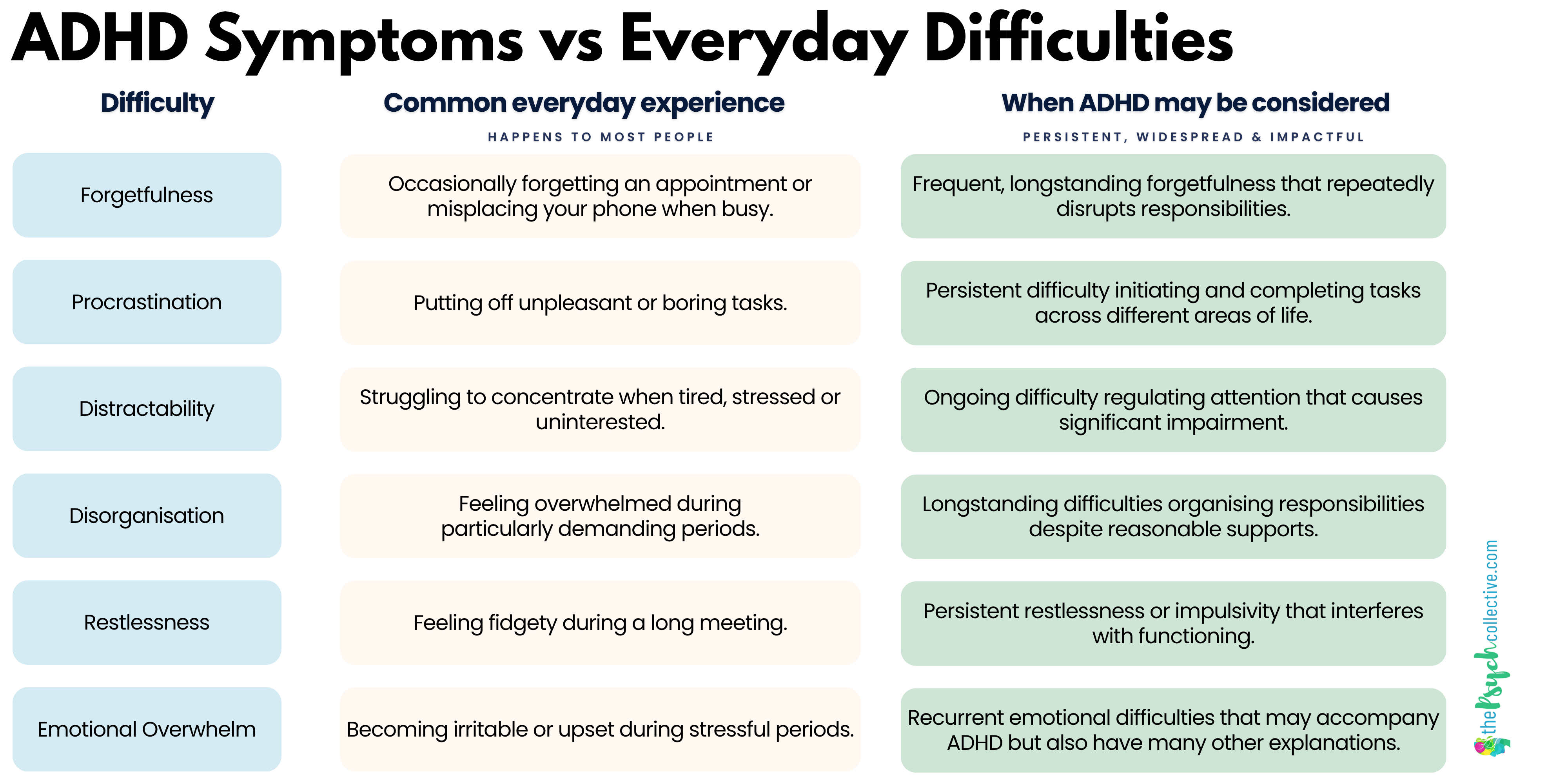
None of these examples can establish a diagnosis on its own.
In our interview with psychologist Peter Bland, we discussed the importance of understanding the impact of someone's difficulties, rather than simply identifying whether particular behaviours occur.
For ADHD, clinicians look for a persistent pattern of symptoms, with several present before age 12, evidence across multiple settings and clear interference with functioning. They must also consider whether another explanation better accounts for the symptoms.
This is why a checklist of relatable behaviours is not enough to diagnose ADHD.
Does procrastination mean you have ADHD?
No. Procrastination is common, and there are many reasons people avoid starting or completing tasks. ADHD is only one possible explanation.
Think about the last time you put something off. Perhaps the task was boring. Perhaps you didn't know where to start. Maybe you were worried about getting it wrong, or you simply had too many other responsibilities competing for your attention. All of these can contribute to procrastination.
People with ADHD may experience persistent difficulties initiating tasks, even when they understand what needs to be done and genuinely want to complete it. But procrastination can also be associated with anxiety, perfectionism, fear of failure, low mood and exhaustion.
Before assuming procrastination is a symptom of ADHD, ask yourself:
Am I avoiding the task because it's unpleasant? Am I overwhelmed by how much there is to do? Am I worried about making a mistake? Do I have enough energy to do it?
The answers may tell you more about the problem than a symptom checklist.
And importantly, you don't need an ADHD diagnosis to work on procrastination. Psychological strategies for managing avoidance, breaking down tasks and improving planning can be helpful regardless of its cause.
Can you have ADHD if you can concentrate on things you enjoy?
Yes. ADHD doesn't mean someone can't concentrate. However, being able to focus intensely on enjoyable activities while struggling with boring ones is not, by itself, evidence of ADHD.
One popular misconception is that people with ADHD can concentrate for hours on something interesting but cannot concentrate on ordinary tasks. This is sometimes described as hyperfocus. For example, someone might spend an entire afternoon playing video games or researching a new hobby but struggle to complete twenty minutes of paperwork.
The difficulty is that this pattern isn't unique to ADHD. Most people find enjoyable activities easier to concentrate on than repetitive or unpleasant tasks. Interest and motivation influence attention in everyone. In ADHD, the concern is a more persistent difficulty regulating attention, particularly when someone needs to shift between tasks or sustain effort despite distractions. The question isn't simply whether you can concentrate on something interesting. It's whether your difficulties managing attention are longstanding, occur across different situations, and significantly affect your functioning.
Is it ADHD, anxiety, depression or stress?
ADHD, anxiety, depression and prolonged stress can all affect attention, memory, motivation and organisation. Understanding the cause is essential because the right interventions may differ.
This is one of the most important issues Peter raised during our discussion about ADHD assessments. Someone might report significant difficulty concentrating, but that doesn't automatically tell us why they're struggling.
Can anxiety cause ADHD-like symptoms?
Yes. Anxiety can interfere with concentration because attention is repeatedly drawn towards worries, anticipated problems and potential threats. You might struggle to follow a conversation because you're thinking about something that could go wrong, or find yourself rereading the same paragraph because your mind keeps returning to a worry. The resulting distractibility can resemble ADHD, but the underlying mechanism may be different.
Can depression affect concentration and memory?
Yes. Depression can affect mental energy, motivation, processing speed and concentration. Someone experiencing depression may find it difficult to make decisions, remember information or complete tasks they previously managed easily. These difficulties can look like inattentive ADHD, particularly when considered without the person's broader emotional state.
Can stress and burnout look like ADHD?
Absolutely. Prolonged stress can leave people mentally exhausted, forgetful, irritable and unable to manage competing demands. When someone is constantly juggling responsibilities, their attention is divided between multiple problems. The result can be poor concentration, reduced efficiency and difficulty organising even straightforward tasks. But these experiences may reflect excessive demands rather than a neurodevelopmental disorder. Of course, ADHD can also occur alongside anxiety, depression or burnout. A careful assessment considers all these possibilities rather than assuming that one diagnosis explains everything.
Why can't I concentrate? Is it ADHD or something else?
Concentration difficulties are a symptom, not a diagnosis. Before attributing them to ADHD, consider what else might be affecting your attention.
Concentration requires sufficient mental energy, manageable emotional arousal, and an environment that lets you direct attention to the task. When any of these are compromised, concentration can deteriorate.
For example, you may struggle to focus because you're sleeping poorly, constantly interrupted, worried about something, emotionally exhausted or attempting to manage an unrealistic workload. It's also worth considering whether your concentration difficulties are recent or longstanding. If you've always struggled to sustain attention across different settings, ADHD might be one explanation worth exploring. If your difficulties began during a particularly stressful period, it's important to investigate the circumstances surrounding that change. New or worsening concentration problems may also warrant a medical review, especially if they're accompanied by changes in sleep, mood, memory, or physical health. The goal is to identify the cause, not just name the symptom.
Why do ADHD symptoms sometimes become more noticeable with age?
ADHD symptoms can become more apparent when life's demands exceed the coping strategies that previously helped someone manage. But increasing responsibilities can also overwhelm people who don't have ADHD.
Peter describes this as a loading issue. A child might manage reasonably well in primary school, where teachers provide structure and parents organise their daily routine. Then they transition to high school and suddenly need to manage multiple subjects, changing timetables and competing assignments. Similarly, an adult might cope well with work and personal responsibilities until they become a parent, take on a demanding job or experience a major life transition. The demands increase, and the person's existing strategies may no longer be sufficient. For someone with ADHD, this can expose difficulties that were previously compensated for.
But we need to be careful not to assume that struggling with increased demands automatically indicates ADHD. If you're managing full-time employment, raising children, caring for ageing parents and sleeping poorly, difficulty concentrating may be an understandable response to your circumstances. Sometimes the problem isn't your capacity to cope. It's how much you're expected to cope with.
Is it ADHD or perimenopause?
Perimenopause and menopause can affect attention, memory, sleep, mood and mental energy. These changes can resemble ADHD symptoms or make existing ADHD difficulties more noticeable.
There has been growing discussion about women recognising ADHD in their 40s and 50s. Some women may have experienced longstanding ADHD symptoms that were overlooked earlier in life, particularly if their difficulties were predominantly inattentive or they developed effective coping strategies.
However, hormonal changes during perimenopause can also contribute to concentration difficulties, forgetfulness and reduced cognitive efficiency. Poor sleep, increased stress and competing responsibilities may further complicate the picture. So, if someone begins experiencing significant concentration problems in their 40s, it isn't necessarily evidence of previously undiagnosed ADHD. You can read more about this in a research article HERE ->
One important question is whether similar difficulties were present during childhood and earlier adulthood. If the symptoms are relatively new, it may be more appropriate to investigate hormonal, psychological, sleep-related or other medical factors. This distinction matters because treating the wrong problem may mean the actual cause remains unaddressed.
Is ADHD being overdiagnosed?
There are legitimate concerns about ADHD being incorrectly diagnosed in some people, while other people with genuine ADHD remain unidentified. Both problems can exist at the same time.
ADHD awareness has increased substantially, particularly through social media. There are benefits to this. People who have experienced longstanding difficulties may finally recognise that an assessment could be useful.
But there are also risks.
Short videos and online symptom lists frequently describe ordinary human experiences as though they are specific indicators of ADHD. You forget why you walked into a room. You have twenty browser tabs open. You procrastinate. You feel overwhelmed. You interrupt someone during a conversation. These experiences may be relatable, but they're not sufficient evidence of a disorder.
When we repeatedly associate common behaviours with ADHD, we risk encouraging people to interpret ordinary variations in attention, motivation and personality as symptoms requiring diagnosis or medication. At the same time, we shouldn't dismiss people whose longstanding ADHD has genuinely affected their functioning.
The solution isn't to diagnose everyone who identifies with a symptom list, nor to dismiss ADHD as a fashionable label. It's to maintain appropriate diagnostic standards. That means examining developmental history, symptom persistence, impairment across settings and alternative explanations before reaching a conclusion.
Does everyone with ADHD need medication?
No. Medication is one evidence-based treatment option for ADHD, but treatment should be individualised according to the person's symptoms, level of impairment, preferences and circumstances.
Medication can be beneficial, particularly when ADHD symptoms significantly interfere with functioning. However, a diagnosis doesn't automatically mean medication is required. Psychological interventions, practical strategies and environmental adjustments can also be important. Someone might benefit from improving their planning systems, reducing unnecessary distractions, developing routines or learning skills for managing emotional reactions. And if their difficulties are primarily caused by anxiety, depression, sleep deprivation or excessive stress, treating those underlying factors may be more appropriate. Medication decisions should follow a careful assessment of the problem, rather than a symptom checklist or an assumption that every attention difficulty requires a prescription.
When should you consider an ADHD assessment?
An ADHD assessment may be worthwhile when attention, organisation or impulsivity difficulties have been present since childhood, occur across multiple settings and significantly interfere with everyday life.
It's also worth considering when the cause of persistent difficulties remains unclear, particularly if ADHD, anxiety, depression or other conditions could explain the symptoms. But not everyone who struggles with concentration needs an ADHD assessment.
If your difficulties are relatively new, coincide with prolonged stress or have emerged alongside changes in sleep, mood or physical health, investigating those factors may be a more appropriate starting point. In our interview, Peter emphasised that a comprehensive psychological assessment should do more than determine whether someone meets the criteria for ADHD. It should help explain the person's difficulties, identify alternative or co-occurring conditions and provide useful recommendations for moving forward.
If you're considering an assessment, our companion article, Is an ADHD Assessment Worth It? GP vs Psychologist Assessments Explained, explores the different pathways, what a comprehensive assessment involves and when it may be worth the investment.
Understanding the Problem Matters More Than the Label
ADHD is a genuine neurodevelopmental disorder, but distractibility, forgetfulness, procrastination, and emotional overwhelm are also common human experiences. Not every attention difficulty indicates ADHD. Not every person experiencing these difficulties needs a diagnosis, and not everyone diagnosed with ADHD requires medication.
At The Psych Collective, our focus is on understanding why someone is struggling, rather than simply attaching a diagnostic label to their experiences.
Sometimes the explanation is ADHD. Sometimes it's anxiety, depression, stress, exhaustion or another factor. And sometimes several things are contributing at once.
The most useful question isn't simply, "Do I have ADHD?" It's "What's causing these difficulties, and what can I do about them?"
If persistent difficulties with attention or organisation are affecting your life and you're unsure of the cause, learn more about psychological assessments at The Psych Collective.
About Our Resources