

The Big Five
We talk a lot about personality disorders within the mental health sphere, but what actually contributes to personality in the first place?
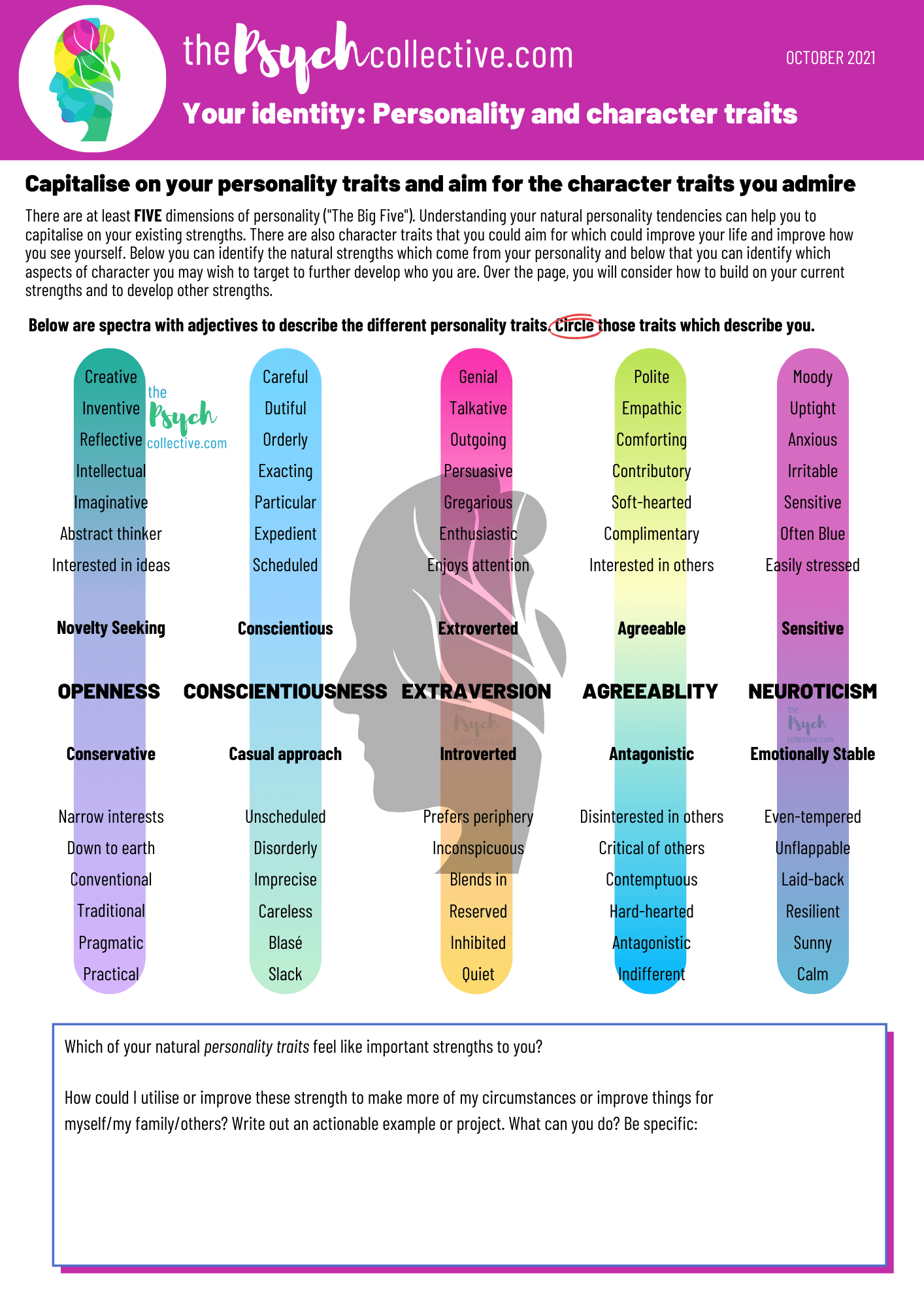
The Big Five inventory, sometimes known as the OCEAN inventory looks at different components of personality. While most psychology students learn it in uni and then never use it again, we dredged it up from the memory banks to explore the utility in therapy. By understanding where you sit across these five factors, you can learn to play to your strengths and make skilful changes where necessary.
OCEAN includes:
Openness
This measures how open you are to new experiences, how much you enjoy novelty, and how imaginative or creative you are.
Too much Openness can lead to impulsivity, risk-taking and thrill seeking.
Too little Openness can be lead to people being close-minded, struggle with creativity and declining new opportunities.
Conscientiousness
This measures how disciplined or controlled you are, how diligent you are on completing tasks and how reliable you are.
Too much Conscientiousness can make people rigid, rule-bound and perfectionistic.
Too little Conscientiousness can lead to people being unreliable, forgetful and disorganised.
Extraversion
This measures how outgoing you are in social situations, Extraverts get their energy from being with people, are happy being the centre of attention and are often assertive people who like to take action.
Too much Extraversion can lead to people dominating others, struggle with isolation and needing external validation
Too little Extraversion (called Introversion) can lead to people being withdrawn, needing a lot of alone time to recharge as they become exhausted or drained by social situations.
Agreeableness
This measures how easily you get along with people, how much you value harmony and how much you care for the needs of others.
Too much Agreeableness can lead to people becoming doormats, feeling scared to rock the boat and struggle with leadership roles.
Too little Agreeableness can lead to people presenting as disgruntled, argumentative and selfish.
Neuroticism
This measures how big your feelings are. Neurotic people feel things more intensely (sensitive temperament) and can have bigger reactions where their emotions are triggered.
Too much Neuroticism will lead to intense feelings that are highly changeable (emotional instability).
Too little Neuroticism can lead to a calm disposition, but perhaps an unhealthy detachment from feelings.
If you are interested in learning more about your personality style, you can complete our Online Assessment which has a mini OCEAN assessment, or click the link below for a more comprehensive assessment of the Big Five Factors.
Alternatively, you can download our handout that explores the Big Five Factors as continuums which may help you to identify your personality characteristics, and also your strengths.
Click on our Resources page to download this free handout.
Share
Categories
About Our Resources
We offer actionable resources and teach real skills to help people make meaningful change in managing mental health issues through different modes depending on people's learning preferences including infographics, text, worksheets, handouts and video.

Ever wondered if you have ADHD? Use our 2-minute self-test to find out

Family therapy in Wollongong with Laura Marett at The Psych Collective. Gottman-informed, trauma-sensitive support to rebuild communication, trust & connection.

What is an accredited mental health social worker and what do they do

Strengthen your relationship with evidence-based couples counselling at The Psych Collective in Wollongong.

Parental burnout puts relationships under real pressure. Laura Marett explains how Gottman Method couples therapy helps partners stay connected through it all.

Heal and rebuild trust after infidelity with Gottman Method couples therapy in Wollongong. Evidence-based support for betrayed and unfaithful partners.

Discover practical, evidence-based strategies to reduce conflict and improve communication in your relationship with couples therapy in Wollongong using the Gottma Method.

Find out how couples counselling works and learn the methods used in this type of therapy.