Schema Questionnaires
Which Schema Questionnaire Should You Use? Comparing the YSQ-L3, YSQ-S3 and YSQ-R
Written by Jess O'Garr, Clinical Psychologist and Schema Therapy trainer at The Psych Collective.
If you are using schema therapy, one of the first things you need to work out is which schemas your patient actually has.
You can absolutely start developing hypotheses about maladaptive schemas through clinical interview, developmental history and simply listening to the themes that repeatedly emerge in therapy. However, questionnaires give us another useful source of information. They provide a systematic way of screening across schemas, identifying which ones appear particularly strong, and sometimes highlighting schemas that neither the therapist nor the patient had initially considered.
The problem is that there isn't just one schema questionnaire.
There are now several versions of the Young Schema Questionnaire (YSQ), and clinicians regularly ask me which one they should use. My answer is pretty straightforward: I recommend the Young Schema Questionnaire-Revised, or YSQ-R.
There are three main versions worth knowing about: the Young Schema Questionnaire Long Form-3 (YSQ-L3), the Young Schema Questionnaire Short Form-3 (YSQ-S3), and the newer Young Schema Questionnaire-Revised (YSQ-R). They all have strengths and weaknesses, but for routine clinical practice, I think the revised version is the Goldilocks questionnaire. Not too long, not too short, and backed by a much-needed psychometric revision of the original measure.
What is the Young Schema Questionnaire?
The Young Schema Questionnaire is a self-report measure designed to assess Early Maladaptive Schemas. Schemas are the deeply held patterns and beliefs that influence the way we understand ourselves, other people and the world around us.
In schema therapy, identifying schemas is important because they help us make sense of the patterns that keep showing up in someone's life.
A person with a strong Abandonment schema may be particularly sensitive to signs that somebody is pulling away. Someone with a Failure schema may interpret mistakes or setbacks as evidence that they are fundamentally incapable. Someone with an Unrelenting Standards schema may constantly push themselves to achieve more while never quite feeling that what they have done is good enough.
A schema questionnaire doesn't diagnose these patterns for us. Instead, it gives us another piece of clinical information that we can combine with the patient's history, current difficulties, coping styles and what we observe in therapy.
That distinction matters. The questionnaire should support your formulation, not replace it.
What versions of the Young Schema Questionnaire are available?
For most clinicians, the three versions you are likely to encounter are:
| Questionnaire | Number of items | Schemas assessed |
|---|---|---|
| YSQ-L3 | 232 | 18 |
| YSQ-S3 | 90 | 18 |
| YSQ-R | 116 | 20 |
The YSQ-L3 and YSQ-S3 assess the traditional 18 Early Maladaptive Schemas. The newer YSQ-R contains 116 items and assesses 20 schemas following revisions to the original schema constructs.
All three use a six-point response scale. Traditionally, schema scores of four or above have been considered clinically meaningful on the YSQ-L3 and YSQ-S3, although I am also particularly interested in items where patients strongly endorse a statement with a five or six.
So, what are the differences?
Young Schema Questionnaire - Long Form 3rd edition (YSQ-L3)
Developed by Dr Jeffrey Young, the third edition of the Young Schema Questionnaire Long Form-3 (YSQ-L3) was published in 2005. It contains 232 questions assessing 18 Early Maladaptive Schemas.
The advantage of the long form is obvious: it collects a lot of information. Each schema is assessed with multiple questions, so you get a detailed picture of the patient's responses.
The disadvantage is equally obvious. There are 232 questions. For many patients, that is simply too much.
In clinical practice, we have to think about more than psychometric purity. We have to think about the person who is actually sitting there completing the questionnaire. Someone who is depressed, overwhelmed, traumatised, struggling with concentration or already drowning in paperwork may not be thrilled when you hand them a 232-item questionnaire.
In my experience, the long form can take around 45 minutes to complete. That is a substantial assessment burden.
If you want a copy of this one, you need to purchase it from https://www.schematherapy.org/
Young Schema Questionnaire - Short Form 3rd edition (YSQ-S3)
In 2005, Jeffrey Young and Gary Brown developed a shorter schema questionnaire. Based on the third edition of the YSQ-L, the short form uses only 90 questions to measure the original 18 maladaptive schemas.
Ninety questions certainly sounds more manageable than 232.
The problem is that I think we've gone a little too far in the other direction.
The short form reduces the assessment burden substantially, which is useful when time is limited or a patient would struggle to complete a longer assessment. However, when you reduce the number of questions, you also reduce the amount of information contributing to each schema score.
And this isn't just my clinical preference. Research directly comparing the measures found that the YSQ-R and YSQ-L3 performed comparably in predictive validity analyses, while both performed better overall than the YSQ-S3.
You'll get this from https://www.schematherapy.org/ as well. Though in all honesty, I think this website is confusing and I don't use these questionnaires anymore. I use the revised and free version below.
Young Schema Questionnaire-Revised (YSQ-R)
While the original Young questionnaires have been our only option for many years, I was thrilled to discover that there is now a revised version and it's free!
The Young Schema Questionnaire-Revised (YSQ-R) contains 116 questions assessing 20 Early Maladaptive Schemas. Developed by Ozgur Yalcin and colleagues for Oz's PhD, they reevaluated the YSQ-L3 using Rasch analysis, resulting in a "goodness of fit" of 116 items. The resulting YSQ-R demonstrated improved fit across the subscales, with good to excellent reliability for most schemas.
There were also some interesting changes to the schemas themselves, as the YSQ-R measured 20 maladaptive schemas, rather than the original 18.
The original Emotional Inhibition schema was separated into Emotional Constriction and Fear of Losing Control, and Punitiveness was separated into Punitiveness-Self and Punitiveness-Other.
Clinically, these distinctions make a lot of sense.
But that is a much bigger conversation, so we will explore the research behind those changes separately.
Which schema questionnaire do I recommend?
For routine clinical practice, my preference is the YSQ-R.
At 116 questions, it is still substantial enough to provide useful information without asking patients to battle through 232 questions. More importantly, its development involved a systematic examination of the measurement properties of the original questionnaire rather than simply creating a shorter version for convenience.
Yalcin's doctoral research directly compared the YSQ-R with the YSQ-L3 and YSQ-S3 and concluded that the YSQ-R and long form performed comparably, with both outperforming the short form overall. Given its combination of brevity and validity, the YSQ-R was recommended for research and clinical settings.
That lines up very nicely with my experience of actually using it with patients.
Where can clinicians access the YSQ-R?
One of my favourite versions of the YSQ-R is the online implementation created by Jason Wessel at Unpack Psychology in collaboration with Dr Oz Yalcin.
I like it because the output is genuinely useful.
Rather than receiving a meaningless wall of numbers, you get a visual report showing the patient's schema scores, along with additional information that makes the results easier to interpret and discuss. The report also includes psychoeducation describing the schemas, so the patient has something meaningful to work with rather than simply being told, "Your Approval Seeking score was high."
For clinicians, you can also create a link with your email address pre-filled so that the completed report comes back to you.
That last part is particularly useful.
Where possible, I prefer the therapist to receive and review the results first so that they can be discussed with the patient in session. Schema questionnaires can bring up some pretty confronting material. A patient receiving a report by themselves and trying to interpret every elevated score without context isn't necessarily helpful.
To use the online version of the YSQ-R with an excellent output (thanks to Jason Wessel), head to Unpack Psychology:
https://www.unpackpsychology.com.au/assessments/young-schema-questionnaire-revised
To download the questionnaire and Excel scoring spreadsheet (built by Oz Yalcon), head to :
https://www.anima.com.au/schema
How should you interpret schema questionnaire results?
The first mistake is assuming that the highest bar on the graph automatically tells you everything you need to know about the patient.
It doesn't.
I look at the schemas that are elevated, but I also look at how strongly individual items were endorsed. If somebody is repeatedly answering five or six across a particular schema, that catches my attention.
I also look at what isn't elevated.
Sometimes the low scores are clinically interesting too.
If someone's history would make you strongly expect a particular schema but their questionnaire shows almost no endorsement of it, that is worth exploring. Why isn't it there? Is the schema genuinely absent? Does the patient understand the questions differently? Are they minimising something? Is a coping mode affecting how they respond?
An anomalous result can sometimes generate a much more useful clinical conversation than an elevated score that simply confirms what you already knew.
Can someone have a schema even if it doesn't appear on the questionnaire?
Absolutely.
This is one of the most important things I teach clinicians about using schema questionnaires.
Psychometrics inform clinical formulation. They do not replace it.
A questionnaire can miss something.
For example, a patient might not score highly on Enmeshment on the YSQ-R, but through therapy you identify a very clear enmeshed relationship and the underlying beliefs and patterns associated with it.
That schema doesn't suddenly cease to exist because the graph didn't turn orange.
This is why I encourage patients to record schemas they recognise in themselves even when those schemas weren't elevated on the questionnaire.
The questionnaire gives us a starting point.
Then we get curious.
What should you do after identifying a patient's schemas?
Completing the questionnaire is not the intervention.
The useful part comes next.
Once we know which schemas appear to be most relevant, we can begin helping the patient understand what those schemas mean, where they came from, what activates them and how they influence their emotions, relationships and behaviour.
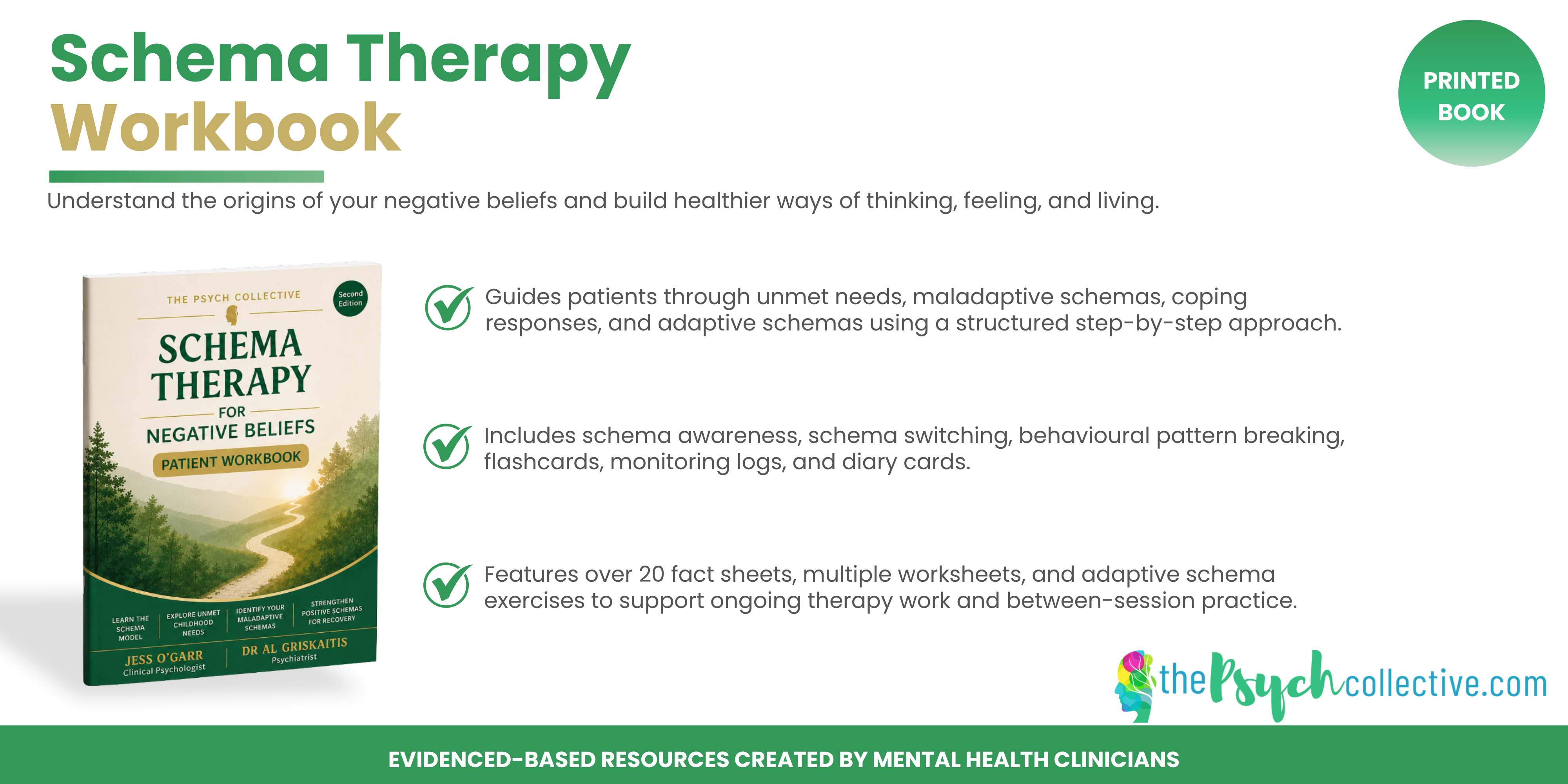
This is exactly why we built schema identification into our Schema Therapy Patient Workbook.
At the beginning of the schema section, patients have space to record their strongest schemas identified through the questionnaire. They can record their top five schemas, followed by another group of schemas that may be moderately elevated or otherwise clinically relevant.
Importantly, there is also room to include a schema that the patient and therapist believe is relevant even if it didn't flag on the questionnaire.
From there, the workbook directs the patient to the corresponding schema fact sheets.
So if Abandonment, Failure and Unrelenting Standards are relevant to you, those are the sections you work through. If Entitlement isn't one of your schemas, you don't need to sit there completing an Entitlement self-reflection exercise just because it happens to be the next page in a workbook.
The assessment determines where you go next.
Why measure schemas again at the end of therapy?
We also return to schemas at the end of the Schema Therapy Patient Workbook.
This gives the patient an opportunity to compare where they started with where they are now.
Schema therapy isn't necessarily about making every schema disappear. These are often deeply established patterns that have developed across many years. What we want to know is whether those schemas have become less intense, less believable and less powerful in the patient's life.
Repeating the assessment also creates a really useful therapeutic conversation.
What has changed?
Which schemas have shifted?
Which ones still get activated?
Which schemas no longer dictate behaviour in the way they once did?
And where is there still work to do?
That turns the questionnaire from a one-off assessment exercise into part of the therapeutic process.
Young Positive Schema Questionnaire (YPSQ)
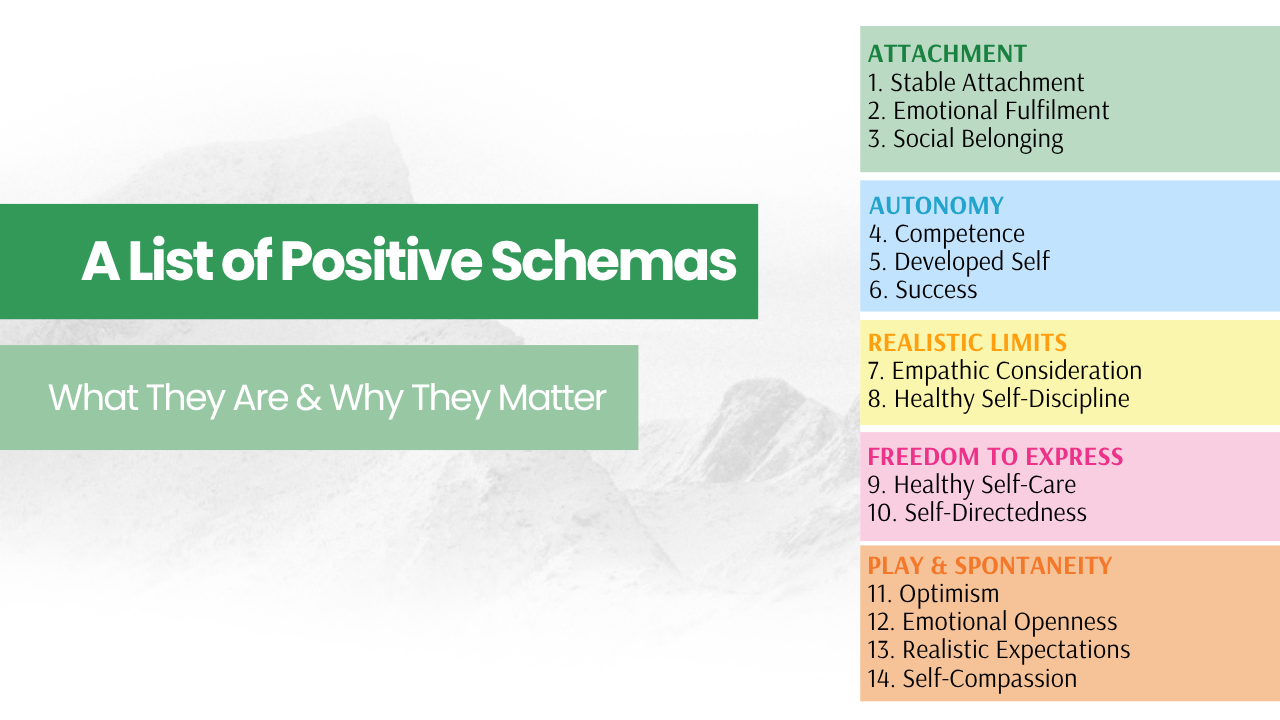
To complement the YSQ-S3, which only measures maladaptive schemas, another team of researchers (Louis, Wood, Lockwood, Ho, & Ferguson, 2018) created a questionnaire to measure adaptive schemas. This 56-item questionnaire measures 14 adaptive schemas that help to operationalise what a Healthy Adult would believe about themselves.
Unfortunately, this questionnaire is not easily available. I contacted the lead author and was advised that he would be happy to share a copy of the questionnaire and scoring sheet, but only if people contact him directly to ask. So he gave me permission to publish his email address so you can ask him for a free copy.
So here is his email: [email protected]
Now, Dr Louis has asked that when you email him, you include in your request for a copy of the YPSQ your full name, which country you are from and the reason that you want a copy (clinical, personal, or research use, or you plan to translate it into another language).
While you're waiting for a reply, here is the reference for his article.
Louis, J. P., Wood, A. M., Lockwood, G., Ho, M.-H. R., & Ferguson, E. (2018, April 19). Positive Clinical Psychology and Schema Therapy (ST): The Development of the Young Positive Schema Questionnaire (YPSQ) to Complement the Young Schema Questionnaire 3 Short Form (YSQ-S3). Psychological Assessment. Advance online publication. http://dx.doi.org/10.1037/pas0000567
Schema Mode Inventory (SMI)
Developed in 2008 and revised in 2009, Jeffrey Young and his team created a questionnaire for measuring the strength of Schema Modes.
The Schema Mode Inventory (SMI) measures schema modes.
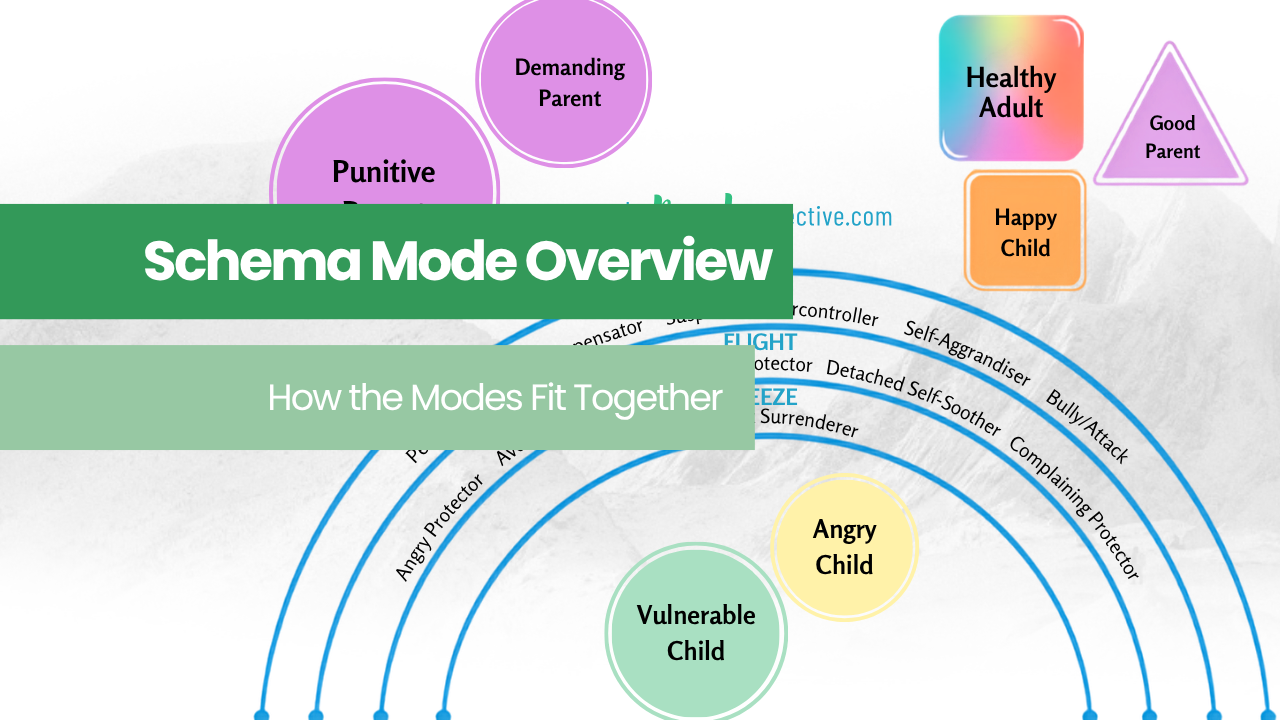
Using 124 questions, it measures 14 modes, including Child Modes, Maladaptive Coping Modes, Dysfunctional Parent Modes and Healthy Adult.
The current version assesses 14 modes, but its clinical usefulness is somewhat limited because it doesn't capture the full range of modes that I use and teach in clinical practice. Of the 14 modes it measures, three I don't routinely use, so it effectively captures only 11 of the 17 modes I teach. So, while the SMI can provide some useful information and may help start a conversation about a patient's dominant modes, I don't rely on it heavily for formulation or treatment planning.
Also note that this questionnaire refers to other modes I don't use, like Enraged Child, Impulsive Child, and Undisciplined Child. Personally, I don't like these labels because they feed into the messages that the child was the problem, instead of remembering that the child is Vulnerable and the problem is with the dysfunctional parents.
A major international consortium involving researchers and clinicians from more than 35 countries is developing the Schema Mode Inventory-3 (SMI-3). The proposed instrument is substantially broader, with 49 schema modes currently being tested. The initial research version contains hundreds of items, which will be psychometrically tested and reduced to shorter, clinically usable subscales. However, the SMI-3 is not yet a validated clinical instrument, and there is currently no published release date. Until that work is complete, the existing SMI remains useful as one source of information, but it should not be treated as a comprehensive assessment of a client's schema modes. The study protocol has been published HERE.
The research version of the questionnaire has 588 items and measures 49 schema modes. That feels overwhelming for me, let alone the patient.
To download the SMI questionnaire and Excel scoring spreadsheet, head to :
https://www.anima.com.au/schema
About Our Resources