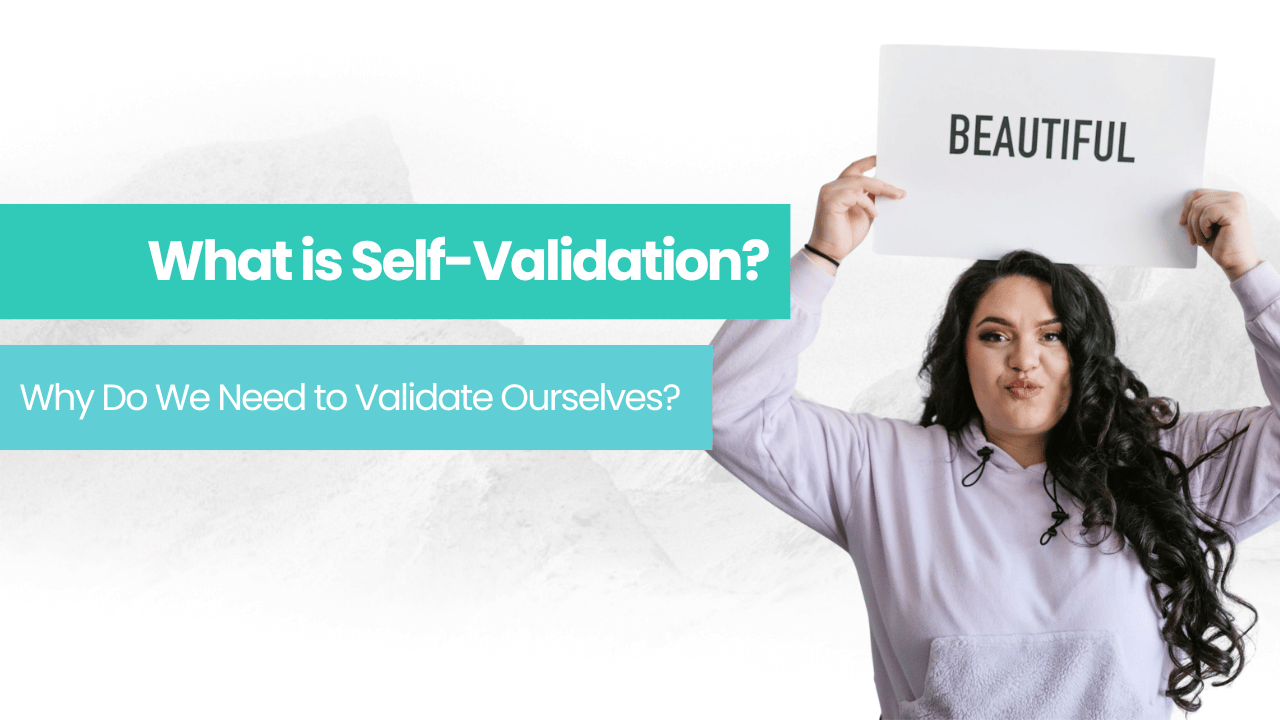
What is Self-Validation?
Self-Validation: An Essential Skill Behind Emotional Regulation
Written by Jess O’Garr, Clinical Psychologist and Dr Al Griskaitis, Psychiatrist
One of the biggest things that makes emotions harder to handle is invalidation.
When people come to therapy struggling with overwhelming emotions, relationship conflict, chronic emptiness, emotional dysregulation, or traits associated with Borderline Personality Disorder (BPD), we often find the same thing sitting underneath it all: a long history of being told that their feelings were wrong.
Not intentionally. Not maliciously.
But repeatedly.
Messages like:
-
"You're overreacting."
-
"It's not that bad."
-
"Stop crying."
-
"You don't have anything to be upset about."
-
"You're too sensitive."
-
"Harden up."
Most people think validation means agreeing with someone. It doesn't.
Validation means recognising and acknowledging someone's emotional experience as real.
When we teach Dialectical Behaviour Therapy (DBT), validation is one of the skills that often creates the biggest shift for clients. Before people can regulate their emotions, they first need to trust their emotions.
And that's exactly what invalidation takes away.
What Is Invalidation?
Imagine you notice that you're hungry.
Your body sends you a signal.
The signal tells you that you need food.
So you eat.
Simple.
Now imagine growing up in an environment where every time you noticed hunger, somebody told you:
"You're not hungry."
"No you're not."
"You don't need food."
"It's all in your head."
Eventually, you would stop trusting the signal.
The same thing happens with emotions.
If you're feeling sad and somebody repeatedly tells you:
"You don't have anything to be sad about."
Then what happens?
You have the feeling.
You think it's sadness.
But you're being told the feeling is wrong.
So now you don't trust the feeling.
And if you can't trust the feeling, you don't know what you're feeling.
And you don't know what to do about it.
This is the beginning of emotional invalidation.
The Cycle of Invalidation
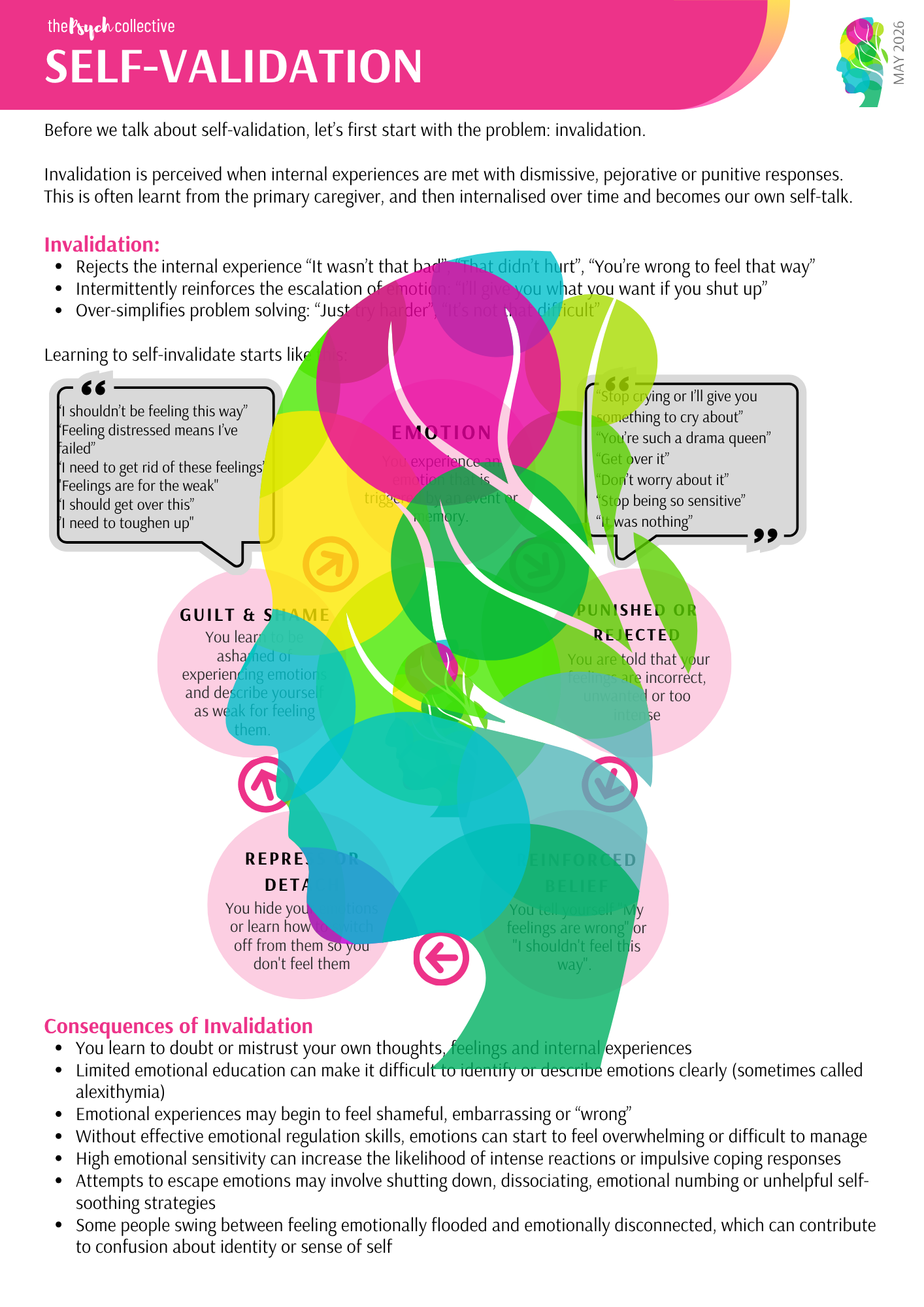
One way we explain this in therapy is through what we call the Cycle of Invalidation.
The cycle typically looks like this:
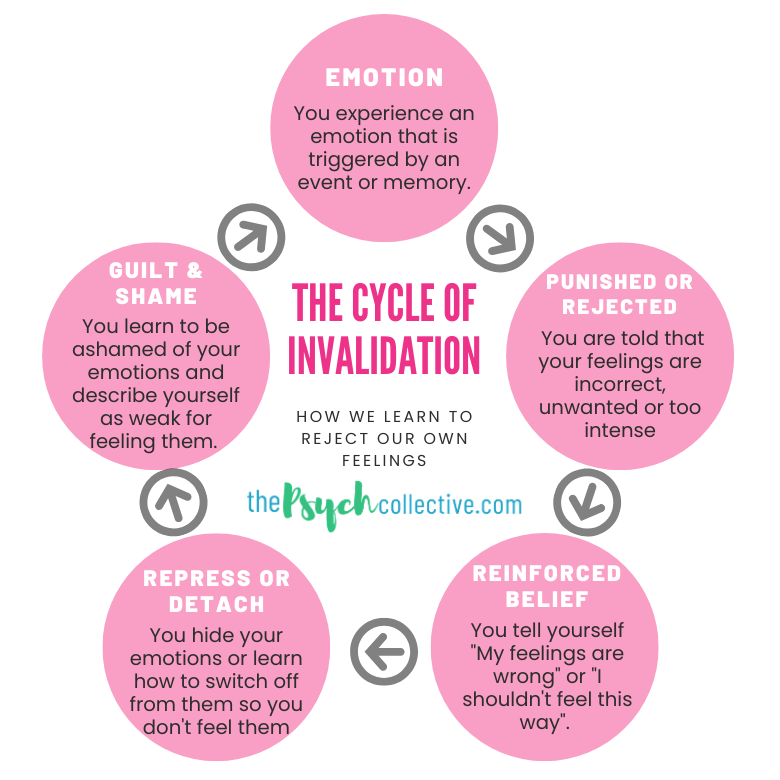
Step 1: An Emotion Occurs
A person experiences a feeling.
Maybe sadness.
Maybe fear.
Maybe disappointment.
Maybe anger.
The feeling itself is normal.
Step 2: The Emotion Is Rejected
Someone responds with:
-
"Stop crying."
-
"You're fine."
-
"It wasn't that bad."
-
"You're being dramatic."
-
"You're too sensitive."
The message becomes:
My feelings are wrong.
Step 3: The Person Tries to Suppress the Feeling
If feelings are wrong, then the logical solution is to stop having them.
So they attempt to:
-
Repress
-
Avoid
-
Detach
-
Dissociate
-
Numb
Unfortunately, emotions don't work that way.
Step 4: The Emotion Breaks Through Anyway
Because emotions are biological signals.
You can't permanently suppress them.
Sooner or later, they return.
Step 5: Shame Appears
Now the person feels:
-
Sad
-
Angry
-
Scared
And ashamed for feeling sad, angry or scared.
The secondary emotion becomes:
"I shouldn't be feeling this way."
Step 6: The Cycle Starts Again
The shame becomes another emotion that feels unacceptable.
And the cycle continues.
Over time, this creates:
-
Emotional confusion
-
Alexithymia (difficulty identifying feelings)
-
Chronic self-doubt
-
Identity disturbance
-
Chronic emptiness
-
Emotional dysregulation
If you can't trust your own internal experience, how are you supposed to develop a stable sense of self?
Why Invalidation Often Comes From Good People
One of the most important things we teach clinicians and clients is that invalidation is usually not malicious.
Parents are often trying to help.
A child falls off a bike.
The parent says:
"You're okay."
"That didn't hurt."
The intention is comfort.
The impact is invalidation.
The child has pain.
The parent says there isn't any pain.
The internal experience and external message don't match.
This doesn't mean Mum or Dad were bad parents.
It means Mum and Dad made parenting mistakes.
That's a very different conversation.
Many parents simply repeat what was said to them.
The cycle gets passed from generation to generation until somebody learns a different way.
Intermittent Reinforcement and Emotional Escalation
Another form of invalidation occurs when only extreme emotions get attention.
Imagine a child asking for a chocolate bar.
First, they ask politely.
No response.
Then they ask louder.
No response.
Then they cry.
No response.
Then they scream in the middle of Woolworths.
Finally:
"Fine. Just take the chocolate bar."
What has the child learned?
Not that feelings matter.
They've learned that only BIG feelings matter.
The lesson becomes:
Low-level emotions get ignored.
Extreme emotions get results.
Many adults continue this pattern.
They don't feel heard until they reach a crisis point.
Some clients describe suicide attempts, self-harm or severe emotional escalation as the first time they felt genuinely seen.
That is incredibly important clinical information.
It tells us that validation was missing long before the crisis occurred.
What Is Validation?
Validation is not agreement.
Validation is not approval.
Validation is not giving someone what they want.
Validation is simply acknowledging their emotional experience.
For example:
A toddler is screaming because they want a chocolate bar.
Invalidation sounds like:
"Stop it."
"You're being ridiculous."
Validation sounds like:
"I can see you're really disappointed."
"I can see you're upset because you wanted a chocolate bar."
Notice something important.
The parent is validating the emotion.
Not changing the boundary.
The conversation continues:
"I can see you're really upset because you wanted a chocolate bar."
"And you're still not getting a chocolate bar."
Validation and boundaries can absolutely coexist.
In fact, they should.
Feelings First. Problem Solving Second.
One of the most common mistakes people make is jumping straight into fixing.
Someone says:
"I'm really struggling."
And the immediate response becomes:
"Have you tried..."
"Why don't you..."
"You should..."
Problem solving is often useful.
But timing matters.
The faster you validate distress, the faster people down-regulate.
Once they're calmer, they return to their window of tolerance.
Then you can problem-solve.
The sequence matters:
Feelings first. Problem-solving second.
Not the other way around.
The Three A's of Validation
When teaching validation, we simplify it into three steps.
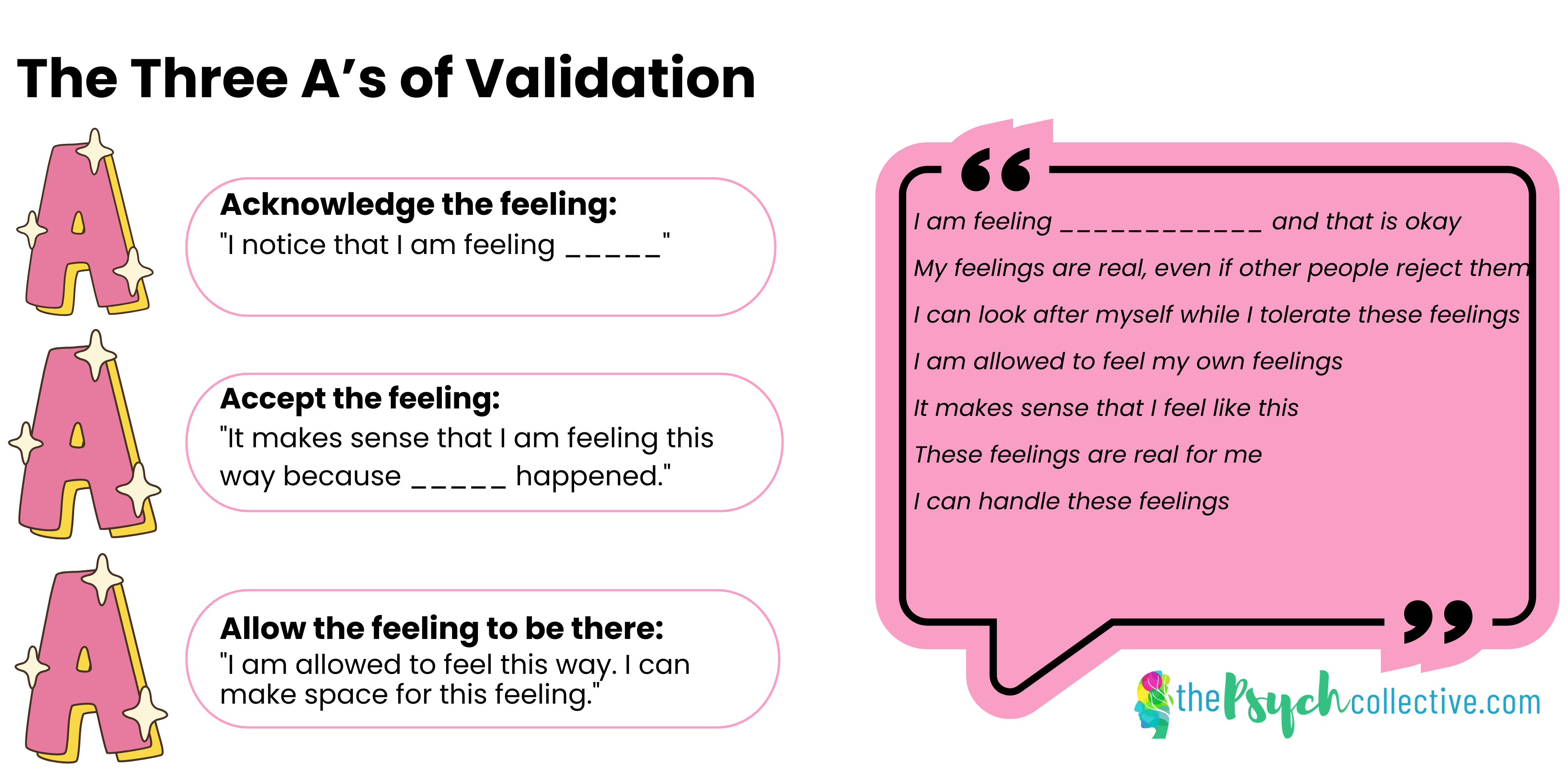
1. Acknowledge the feeling
Notice and name the feeling.
Use simple language.
Examples:
"I notice that I'm feeling anxious."
"I notice that I'm feeling sad."
"I notice that I'm feeling disappointed."
The goal is simply recognising what is happening.
2. Accept the feeling
Give yourself permission to have the feeling.
Examples:
"It makes sense that I'm feeling anxious because this presentation is important to me."
"It makes sense that I'm feeling sad because that relationship ended."
"I'm allowed to feel this way."
This step is crucial.
We stop fighting the emotion.
We stop arguing with reality.
3. Allow the feeling to be there
"I am allowed to feel this way. I can make space for this feeling."
Ask:
What does this feeling need?
Examples:
-
Fear may need reassurance.
-
Sadness may need comfort.
-
Anger may need boundaries.
-
Exhaustion may need rest.
Examples:
"I can look after my anxious feelings by doing some breathing."
"I can look after my sadness by calling a friend."
"I can look after my stress by taking a break."
Validation isn't just noticing the feeling.
It's responding to it.
What Validation Sounds Like
Helpful validation statements include:
For Sadness
-
"That sounds really hard."
-
"I can see why you're upset."
-
"Anyone in your position would probably be struggling."
-
"It makes sense that you're feeling this way."
For Anxiety
-
"I can understand why you're worried."
-
"That sounds stressful."
-
"I can see why that would make you nervous."
For Anger
-
"I can see why you're frustrated."
-
"It makes sense that you're angry."
-
"I'd probably be annoyed too."
For Disappointment
-
"I can see how disappointing that would be."
-
"You worked really hard for that."
What Not To Say
These responses usually create invalidation:
Sadness
❌ "Don't be sad."
❌ "It could be worse."
❌ "You've got nothing to be upset about."
Anxiety
❌ "Just calm down."
❌ "Stop worrying."
❌ "It's not a big deal."
Anger
❌ "You're overreacting."
❌ "You're too sensitive."
❌ "Just get over it."
General
❌ "At least..."
❌ "You should..."
❌ "That's nothing compared to..."
Even when these comments are well-intentioned, they often communicate:
Your emotional experience is wrong.
The Goal of Validation
The ultimate goal isn't external validation.
The goal is internal validation.
Many people come into therapy with almost no capacity to validate themselves.
So initially, the therapist does a lot of the validating.
We pour into the cup.
Over time, however, the person learns to do it for themselves.
Because eventually they need to be able to say:
♥️ I know what I'm feeling.
♥️ I understand why I'm feeling it.
♥️ I'm allowed to feel this way.
♥️ I know how to look after myself.
That's emotional maturity.
That's emotional regulation.
Before people can regulate emotions, they need to trust emotions.
Before they can trust emotions, they need to stop treating them as the enemy.
Validation is not about agreeing with every feeling.
It's about recognising that feelings are information.
And when we learn to listen to that information rather than fight it, emotions become far easier to manage.
Need More?
Download the Self-Validation handout that describes the cycle of invalidation and the skills needed to learn how to self-validate.
About Our Resources