Borderline Personality Disorder
What is Borderline Personality Disorder?
Written by Jess O'Garr (Clinical Psychologist) and Dr Al Griskaitis (Psychiatrist)
Borderline Personality Disorder (BPD) is one of the most misunderstood mental health conditions.
Unfortunately, the name doesn't help.
The term "borderline" originated decades ago when clinicians believed some people sat on the border between neurosis and psychosis. Today, very few mental health professionals view BPD that way, yet the label remains.
The ICD-11 has attempted to move away from the term by using Emotionally Unstable Personality Disorder, but many clinicians and consumers dislike that label, too.
At The Psych Collective, we think there is a much simpler way to understand BPD:
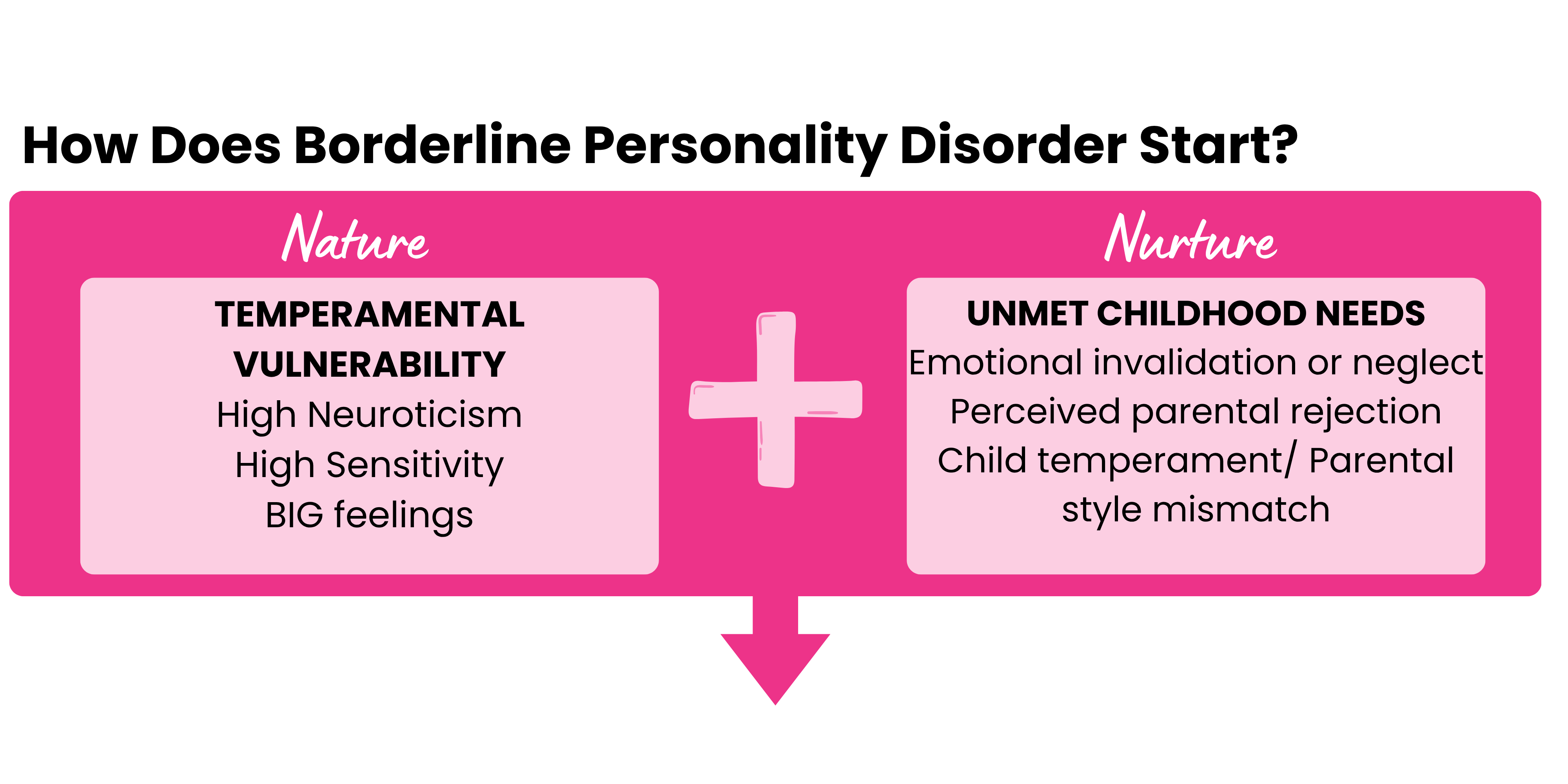
BPD occurs when one has a hypersensitive temperament and insecure attachment, This combination results in an unstable sense of self, with episodes of extreme distress that lead to regrettable actions.
Does Temperament Influence BPD?
Temperament plays a major role. The more sensitive the temperament, the more likely Borderline Personality may manifest in the context of trauma, invalidation or unmet emotional needs.
Some people are born more emotionally sensitive than others. This personality trait is referred to as neuroticism. We sometimes describe it to clients as:
"High neuroticism is like having an emotional peanut allergy without an EpiPen."
Small emotional triggers can create very large emotional reactions.
These individuals often experience:
- Stronger emotions
- Faster emotional escalation
- Greater difficulty calming down
- Increased sensitivity to rejection or criticism
What are the Symptoms of BPD?
There are 9 symptoms for BPD, and a person must have 5 or more ot meet criteria. However, the diagnostic criteria for Borderline Personality aren’t very integrated. We've rearranged the list of symptoms so they make sense.
Borderline Personality Disorder usually occurs when a child with a highly sensitive temperament is raised in an environment that can't or won't meet their emotional needs, resulting in (often accidental) emotional invalidation.
Living in an invalidating environment causes the following difficulties:
- Fear of abandonment, and then frantic efforts to avoid that
- A fluctuating sense of self-identity
- Chronic emptiness
Living a life with these difficulties often results in the following:
- Unstable mood
- Impulsivity
- Anger
- Suicidal behaviour or threats
- Stress-related paranoia or dissociation
Then, because of these behaviours, there is stress in relationships, resulting in the final symptom:
- Unstable interpersonal relationships
That relationship instability feeds the abandonment fear, perpetuates the emptiness and the unstable sense of self. That’s it.
So that puts the diagnostic criteria into a framework which makes sense.
Why small things can cause big reactions in BPD
On a practical level, the problem is sensitivity to invalidation and a tendency to make biased, reflexive judgments. This tendency stems from temperament and childhood experiences, especially persistent invalidation by caregivers. Trauma, chaos and uncertainty can be major factors.
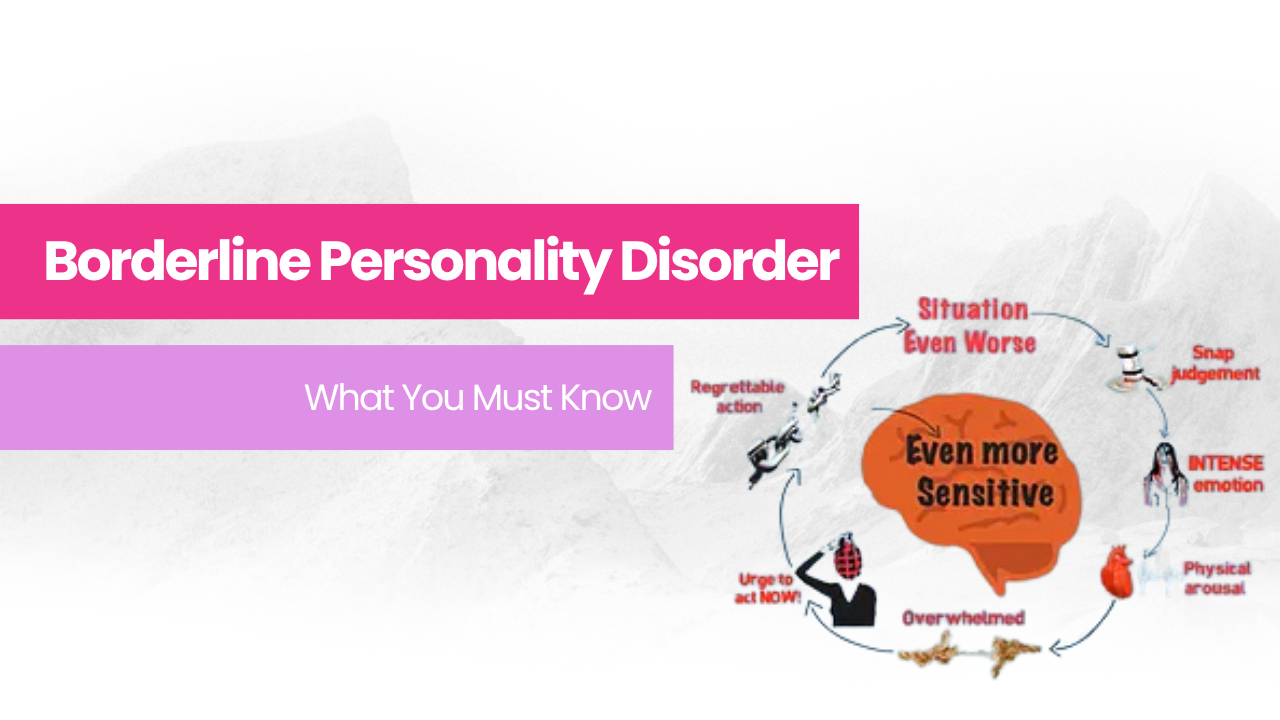
In adulthood, the combination of a sensitive temperament and reflexive (often biased) judgments manifests as emotional overwhelm. Emotional Distress is the most obvious feature of BPD. When overwhelmed, physiological changes mean that logic goes out the window. Anger becomes rage, fear becomes terror, sadness becomes despair. The emotions come with urges to act them out: rage/attack, terror/cling or flee, despair/self-harm.
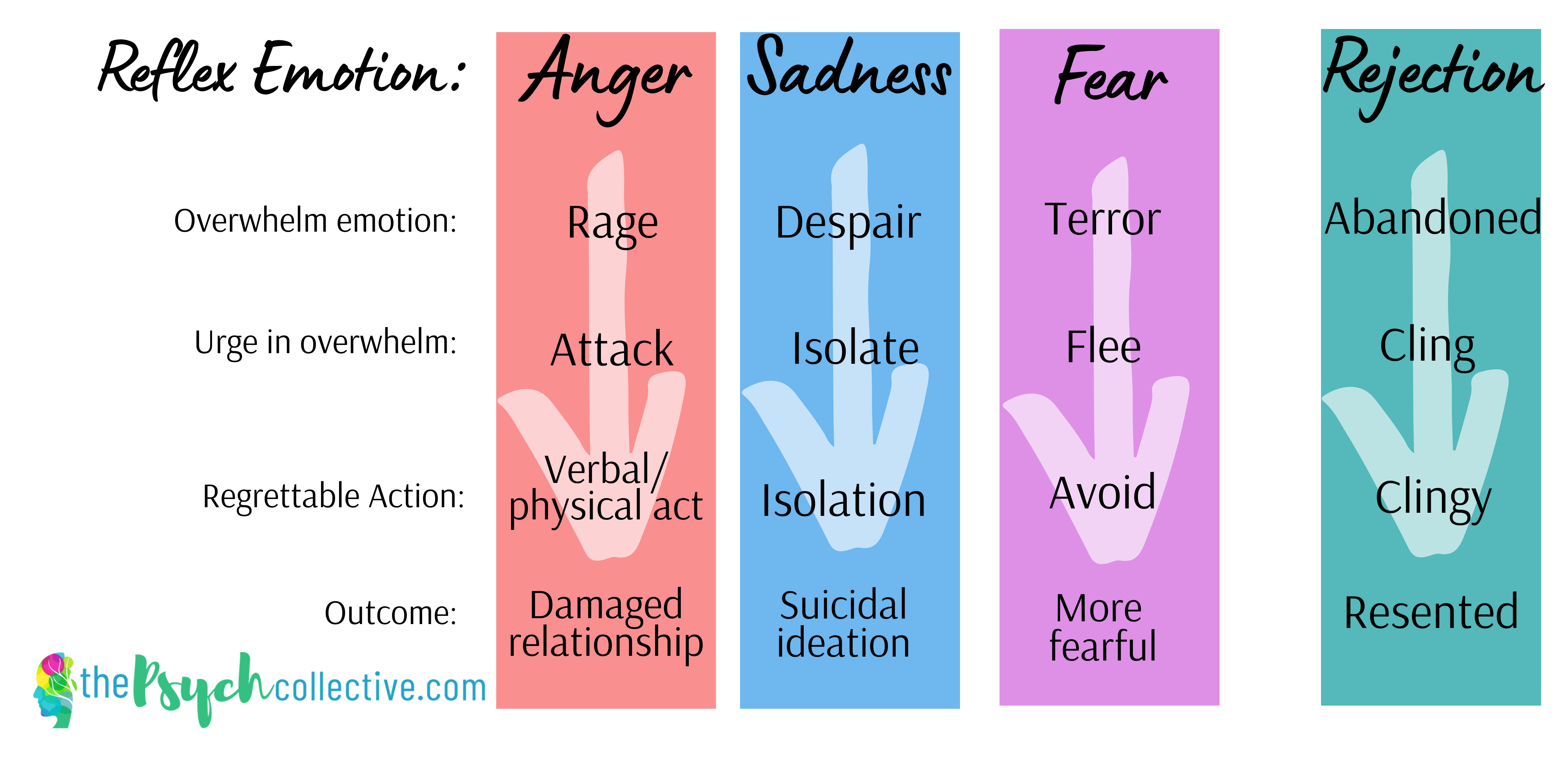
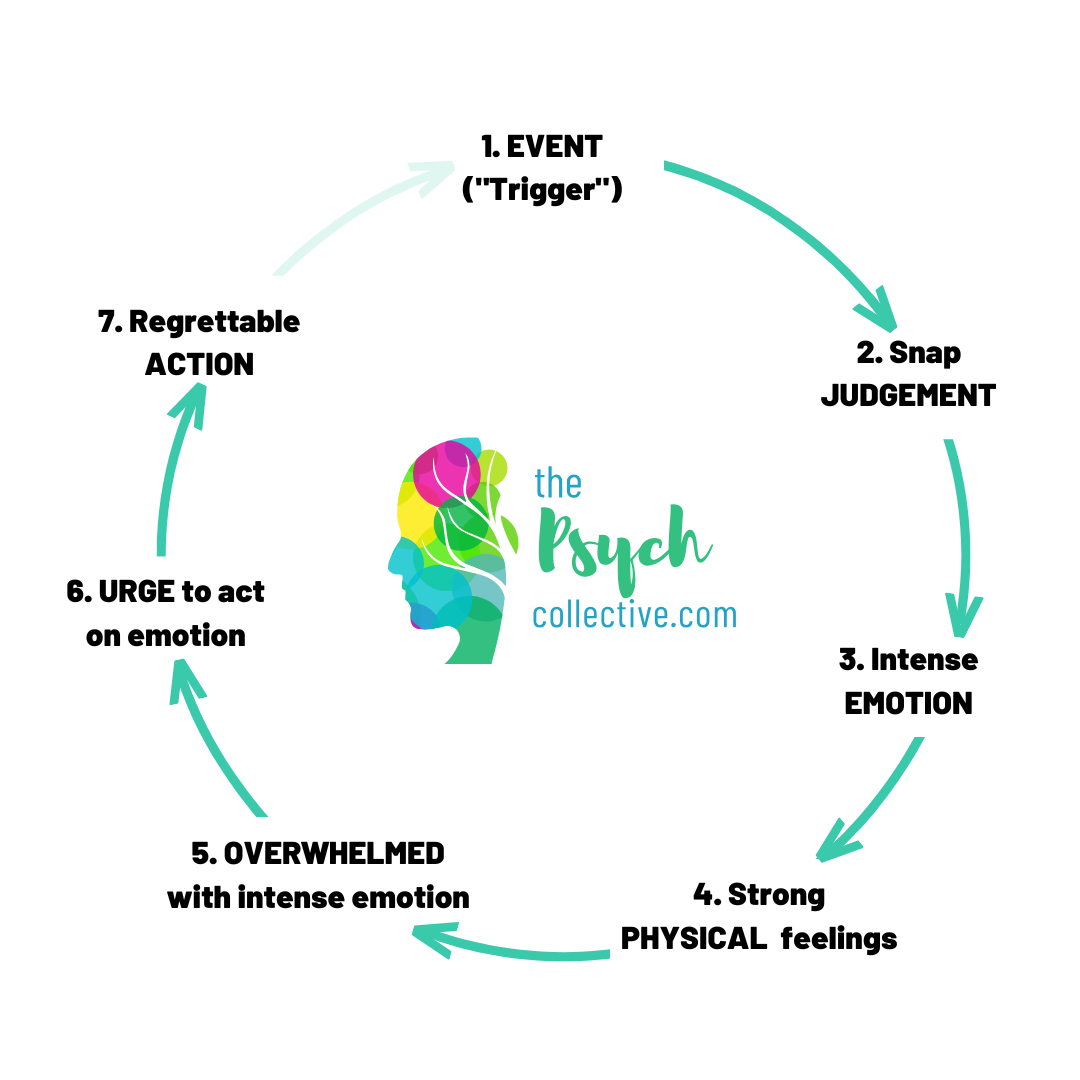
The affect and anger dysregulation is the manifestation of the emotional distress, as is dissociation, self-harm and suicidality. This is the basis of “The Distress Cycle” (see below).
The Distress Cycle provides a framework which can help with that process. People can learn how to become less reactive. Once people get insight into their biases and snap judgments, they don’t tend to become distressed, and then relationships improve. Life starts getting better. But it’s work. Important work. This clip has more on that framework, if this resonates with you.
Is there a Cure for BPD?
In terms of “cure”, it’s about improving sensitivity, reducing and noticing the proclivity to make reflexive judgements, and being aware of the particular biases that predispose a person with BPD to make them. That can be learned. It’s also about having an approach to overwhelm and the urge to act out overwhelming emotions. These are critical skills. Psychotherapy might help people understand themselves broadly. But we need to start by understanding what happens as we become distressed and what to do about that.
Is BPD the same as Bipolar Disorder?
No.
BPD and Bipolar Disorder can both involve mood instability, but they are different conditions.
Bipolar Disorder tends to involve distinct mood episodes, such as depression, hypomania or mania, that last for days, weeks or longer.
BPD mood shifts are usually more reactive, more interpersonal and more rapid.
A person with BPD may shift from despair to rage to panic in the same day, or in the same hour, depending on what is happening in their relationships and nervous system.
It is possible to have both, but they should not be treated as the same thing.
Is BPD the same as Complex PTSD?
BPD and Complex PTSD overlap, but they are not identical.
Both can involve emotional dysregulation, shame, relationship difficulties and a negative sense of self.
The difference is that Complex PTSD requires exposure to significant trauma, whereas BPD is often better explained by the combination of high emotional sensitivity, insecure attachment and chronic invalidation.
Some people have both.
This matters because treatment may differ. People with BPD often benefit from DBT skills and therapies that target emotional regulation and attachment patterns. People with Complex PTSD may also require trauma processing, such as EMDR, once they have enough stabilisation skills.
What treatment helps BPD?
Good treatment for BPD usually requires several things.
1. Build distress tolerance
The first step is learning how to survive emotional storms without making things worse.
This includes grounding, slowing down, using the body to down-regulate, delaying action and getting through the peak of distress.
2. Understand the distress cycle
People need to learn what happens between a trigger and a regrettable action.
The key questions are:
- What triggered me?
- What meaning did I make of it?
- What emotion came up?
- What urge did I have?
- What did I do?
- What happened next?
- What could I try next time?
3. Identify reflex judgments
BPD is often maintained by fast, biased interpretations.
Treatment helps the person notice these judgments and ask:
- Is this a fact or a fear?
- What else could this mean?
- Am I reacting to the present or the past?
- What would I say if I felt safe right now?
4. Learn relationship skills
People with BPD often need practical skills for asking for reassurance, setting boundaries, repairing conflict and tolerating distance without escalating.
5. Work on attachment wounds and core beliefs
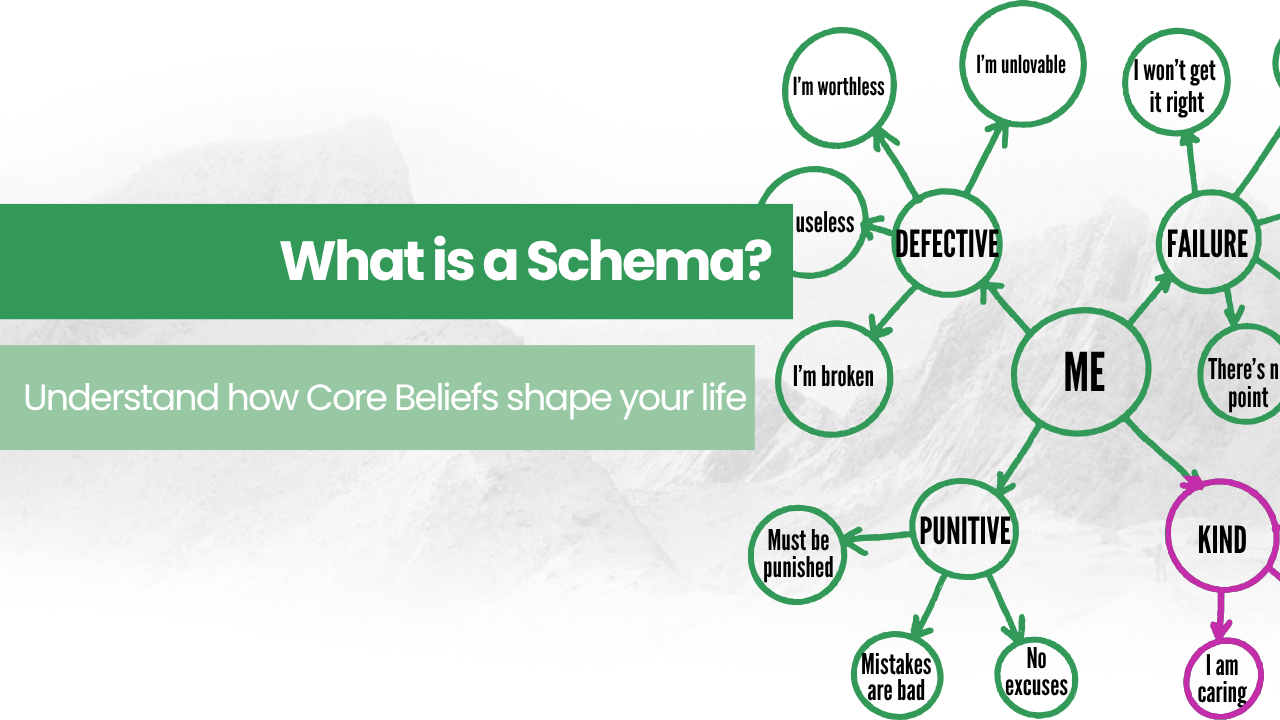
Once the person has enough skills, therapy can then work more deeply on the beliefs underneath the distress, such as:
- “I am unlovable.”
- “People always leave.”
- “My feelings don’t matter.”
- “I am too much.”
- “I have no stable self.”
This is where therapies such as Schema Therapy, DBT-informed therapy, EMDR and trauma-focused work may be useful, depending on the person’s presentation.
What Resources do you have for BPD?
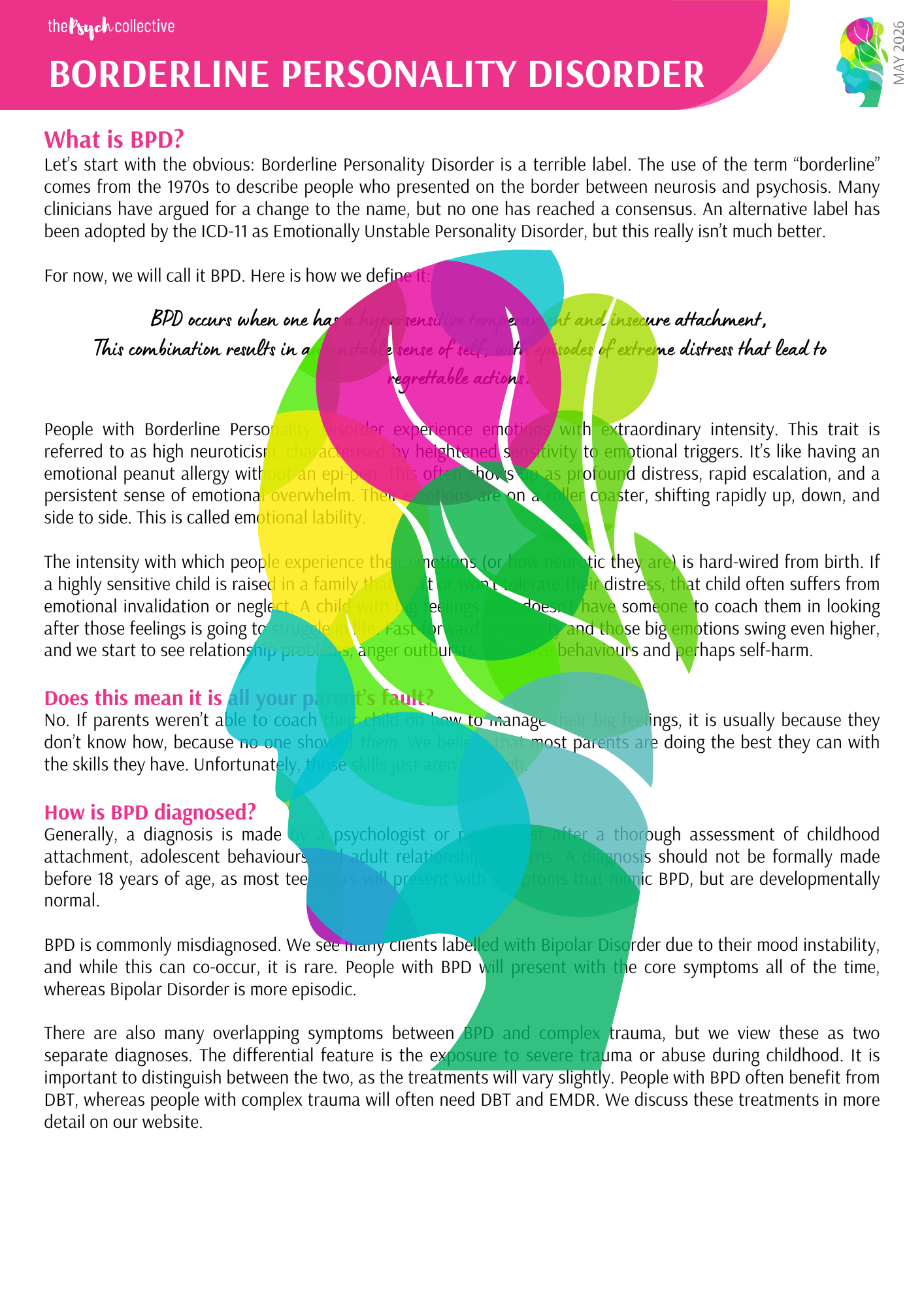
We have a handout you can download on "Understanding BPD". Click here
We also have an online course designed for people who experience emotional overwhelm and Disress. You can read more about that here.
About Our Resources