The Psychology of Doomscrolling - and how to break the habit
Guilty about over-scrolling? Try a more meaningful habit

The Psychology Behind Mindless Scrolling—and How to Break the Habit
Ever wonder why you can't stop scrolling through your phone? You're not alone. Sometimes called Doomscrolling, it eats up our lives, minute by minute. Life can slip through our fingers and that feels meaningless and is demoralising when we waste too much time.
Doomscrolling: Here's why it happens and how you can mitigate it.
1. Your Default "Seeking Mode"
Humans we are natural foragers. Just as our ancestors searched for both food and information. We mostly have plenty of food so we can now focus that drive to seek new information.
Our phones offer an endless stream of content, satisfying our evolutionary drive to explore.
2. Variable Reward Reinforcement
Scrolling is like playing a slot machine. The unpredictability of finding interesting content keeps us hooked, this is well understood and known as "variable reward reinforcement". Each "hit" of engaging content releases dopamine, reinforcing the habit. The social media companies could just give you the content you really like, but you'd get sick of that and disengage. So instead they feed the good stuff like little prizes among the mediocre stuff.
We tire of predictable rewards, but we don't tire of unpredictable ones.
3. Soothing and Safe Foraging
Scrolling provides a safe, passive way to relax and escape daily stress. It allows us to learn and feel in control without real-world risks. Binge-watching TV shows is another common way to soothe ourselves. While it can be a valid way to recharge, it's easy to overindulge. Excessive binge-watching, like excessive scrolling, can lead to feelings of guilt and shame. These negative emotions often arise when indulgence becomes chronic, overshadowing more meaningful activities. We feel we have "wasted our day" and that time "slips through our fingers" when we don't do anything meaningful.
How to Break the Habit
Meaningful Rewards: Seek rewards that truly matter to you.
Set aside a few minutes now. Ask yourself, "What could I do instead of this that would be meaningful?"
Close your eyes and listen to what your subconscious offers.
Engage in Fulfilling Activities: Replace mindless scrolling with activities that have deeper significance. Whether it's pursuing a hobby, learning something new, or working on a meaningful project, find what resonates with you.
Balance Soothing Activities: It's okay to use your phone for relaxation, but diversify your relaxing activities to include more enriching experiences.
Reflect on Your Screen Time: If you're embarrassed about how much time you spend on your phone, it's a sign you need a change. That guilt/shame is often a sign you're doing something against your "gut values." Replace mindless scrolling with activities that offer real value and fulfillment.
It's perfectly fine to scroll or binge-watch occasionally to relax and recharge, but are you happy with that as your primary method of coping? Have activities ready for when you feel recharged enough to switch from scrolling/binging to those that align with your "gut values" and provide lasting satisfaction and a sense of accomplishment.
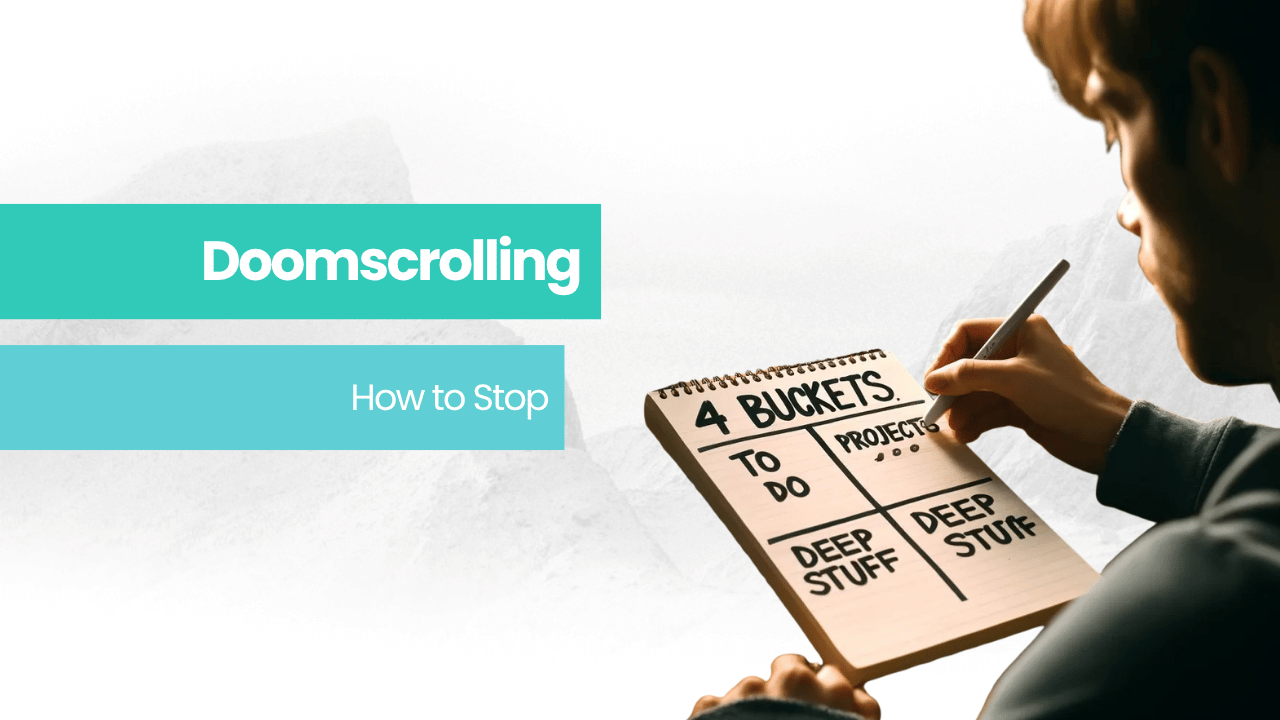
Action Step: Use the Four Buckets Technique to Find Goals, Projects and Deeper stuff
To break away from mindless scrolling, use the Four Buckets Technique to categorize your thoughts and tasks. This method helps you organize your mental space and prioritize meaningful activities.
Take 10-20 minutes in a quiet space and see what thoughts bubble up.
Categorize Your Thoughts: Write each thoughts under it's 4 Buckets category
-To Do,
-Projects,
-Deeper Stuff, and
-Junk.
- To Do Soon: Identify immediate, actionable tasks. Small wins should be appreciated.
- Projects: Ideas, longer-term goals and projects. Each step towards to goal is a small win.
- Deeper Stuff: Reflect on significant, personal tasks that require thoughtful attention.
- Junk: Acknowledge trivial thoughts and let them go if they don't matter.
Attending to the ideas you generate ad hoc is fine, having a routine which incorporates scheduled time for "To do's" and "Projects" is even better. Regularly revisit the "Deeper Stuff" bucket to ensure you're addressing long-term personal goals and get help if you need it.
Conclusion
Understanding why we scroll and binge-watch can help us make better choices. By all means, recharge, but be wary of chronic overindulgence. By finding meaningful rewards and engaging in fulfilling activities, we can break the cycle of mindless indulgence and lead more enriching lives.
If you find yourself overdoing the scrolling, stop and do the 4 buckets and find something more meaningful.
We have a worksheet here if you'd like a nice neat form to use in doing the 4 buckets:
About Our Resources