The Big Five
The Big 5 Personality Traits:
Understanding Yourself Without Labelling Yourself
By Jessica O'Garr (Clinical Psychologist) and Dr Al Griskaitis (Psychiatrist)
When people hear the word personality, they often think of personality disorders, personality tests on social media, or broad labels like "introvert" and "extrovert".
But personality is far more interesting than that.
At The Psych Collective, we spend a lot of time helping people understand why they think, feel and behave the way they do. While many psychological problems involve distress, trauma, anxiety, depression or relationship difficulties, underneath these struggles sits something more stable: your personality.
Personality influences how you respond to stress, how you connect with others, what motivates you, and even the types of difficulties you are most vulnerable to.
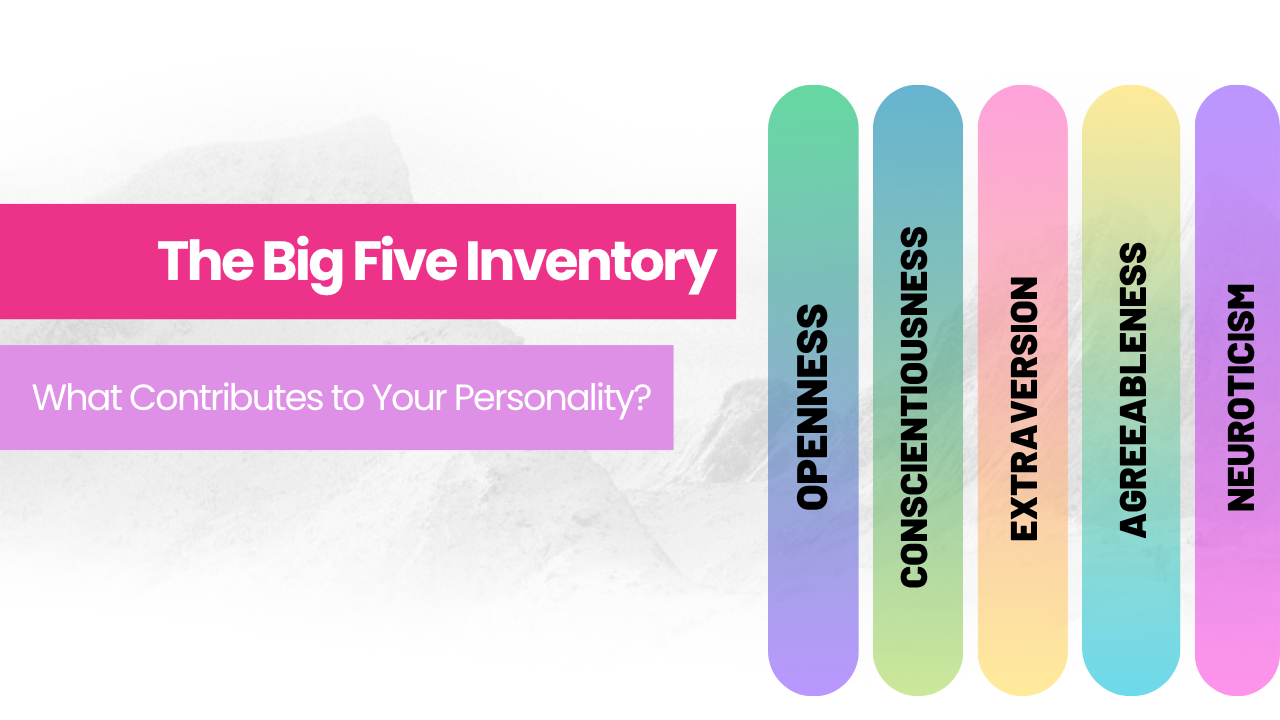
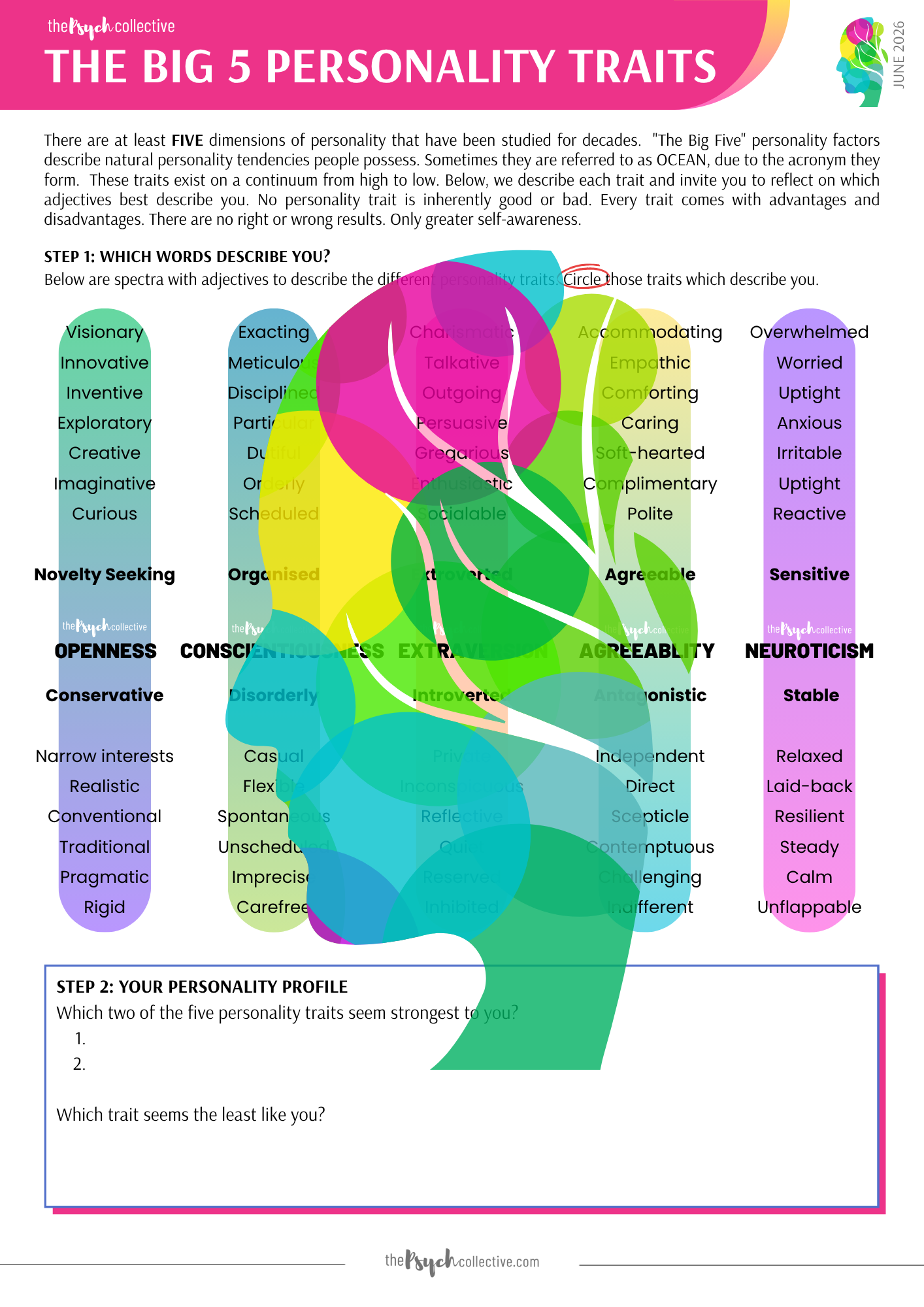
One of the most well-researched ways of understanding personality is called the Big Five Personality Model, sometimes referred to as OCEAN. Decades of research suggest that most personality characteristics can be understood through five broad traits:
- Openness
- Conscientiousness
- Extraversion
- Agreeableness
- Neuroticism
Our new Big Five Personality Traits worksheet explores these traits as continuums rather than categories, helping people identify their natural tendencies, strengths, and potential blind spots.
The goal is not to decide whether your personality is "good" or "bad".
The goal is greater self-awareness.
What Are the Big Five Personality Traits?
The Big Five model proposes that personality exists across five dimensions that naturally vary from person to person.
Importantly, these traits are spectra, not boxes.
You are not simply "an extrovert" or "an introvert".
You may be moderately extroverted, highly conscientious, low in openness, and highly agreeable.
Every combination creates a unique personality profile.
One of the key messages we emphasise in our worksheet is that no personality trait is inherently good or bad. Every trait comes with advantages and disadvantages.
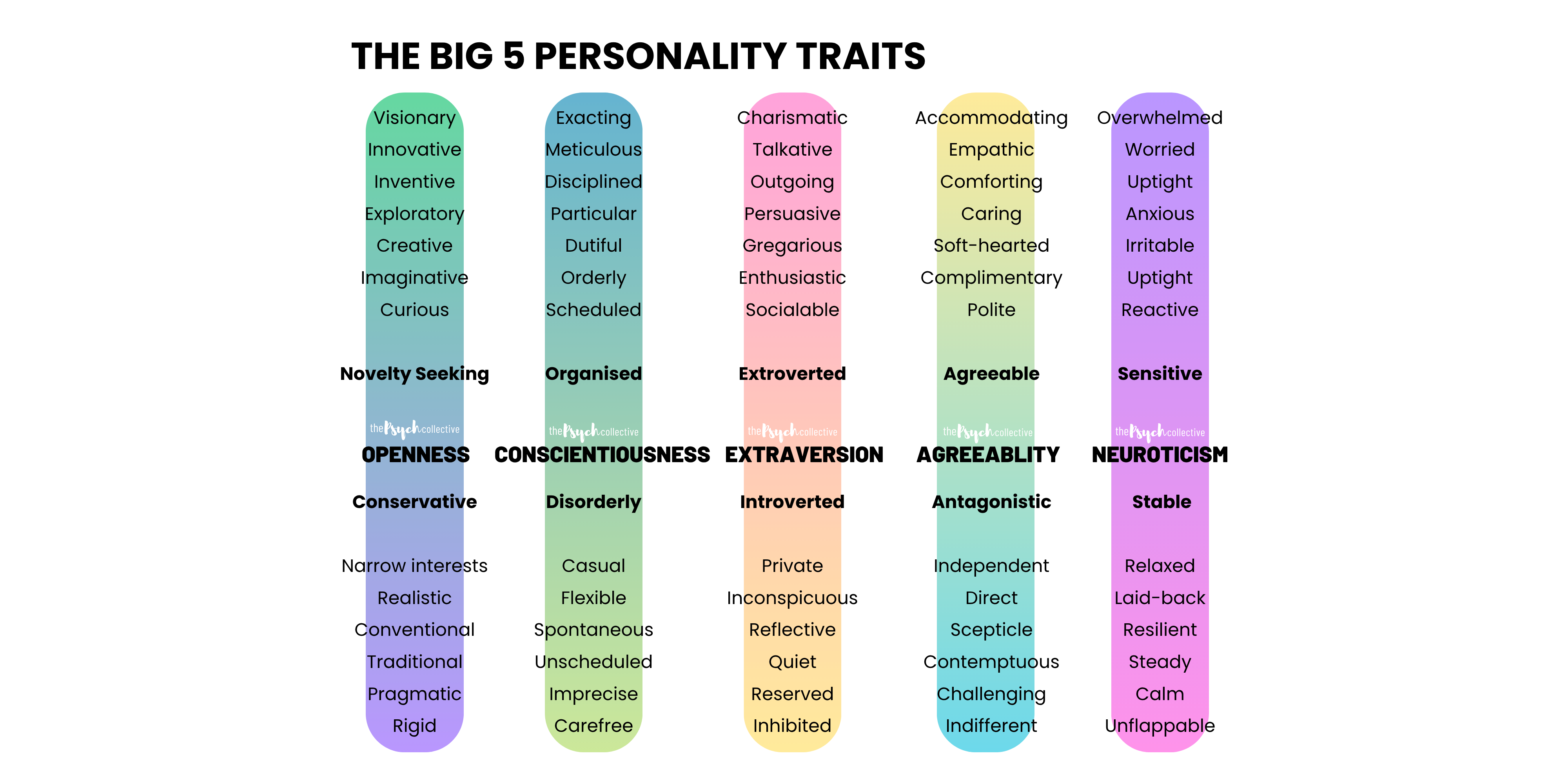
Here is an overview of each personality trait:
1. Openness: How Much Do You Seek Novelty and New Experiences?
Openness reflects your willingness to explore new ideas, experiences and possibilities.
People who score high on openness are often described as:
- Visionary
- Innovative
- Inventive
- Exploratory
- Creative
- Imaginative
- Curious
These are the people who enjoy learning, experimenting, travelling, creating and thinking outside the box.
The Strengths of High Openness
High openness often contributes to:
- Creativity
- Innovation
- Flexibility
- Problem-solving
- Adaptability
Many entrepreneurs, artists, researchers and inventors score highly on openness.
The Hidden Costs of High Openness
Like every personality trait, openness can become unhelpful when taken too far.
People who are extremely high in openness may:
- Become distracted by new ideas
- Jump from project to project
- Seek novelty at the expense of consistency
- Engage in impulsive risk-taking
- Struggle to finish what they start
The Other End of the Spectrum
People lower in openness tend to be:
- Pragmatic
- Conventional
- Traditional
- Realistic
- Conservative
- Structured
While society often celebrates creativity, lower openness has advantages too.
These individuals often provide stability, practicality and consistency. They can be excellent at maintaining routines, preserving traditions and making realistic decisions.
2. Conscientiousness: How Organised and Reliable Are You?
Conscientiousness measures self-discipline, organisation and follow-through.
People high in conscientiousness are often:
- Exacting
- Meticulous
- Disciplined
- Dutiful
- Orderly
- Scheduled
- Organised
These are often the people who make lists, arrive on time, meet deadlines and keep promises.
The Strengths of High Conscientiousness
Research consistently shows conscientiousness is associated with:
- Reliability
- Achievement
- Goal completion
- Planning
- Productivity
Our worksheet highlights reliability and follow-through as major strengths associated with this trait.
The Hidden Costs of High Conscientiousness
When conscientiousness becomes exaggerated, it can evolve into:
- Perfectionism
- Rigidity
- Over-control
- Excessive self-criticism
- Difficulty relaxing
One of the most common patterns we see in therapy is organised people becoming perfectionistic under stress.
These individuals may spend so much time trying to get things "right" that they struggle to get started at all.
The Other End of the Spectrum
People lower in conscientiousness may be:
- Flexible
- Casual
- Spontaneous
- Adaptable
- Easy-going
While they may struggle with organisation, they often cope better with uncertainty and change.
3. Extraversion: Where Do You Get Your Energy?
Extraversion describes how energised you feel by social interaction.
Highly extroverted people are often:
- Charismatic
- Talkative
- Outgoing
- Persuasive
- Gregarious
- Enthusiastic
- Sociable
These individuals tend to enjoy being around others and often thrive in social environments.
The Strengths of High Extraversion
High extraversion is often associated with:
- Confidence
- Assertiveness
- Leadership
- Social connection
- Action-taking
They often find it easier to build networks, initiate conversations and advocate for themselves.
The Hidden Costs of High Extraversion
Taken too far, extroversion can contribute to:
- Dominating conversations
- Acting before thinking
- Seeking constant stimulation
- Difficulty being alone
- Dependence on external validation
The same confidence that helps someone lead can sometimes become overwhelming for those around them.
The Other End of the Spectrum: Introversion
People lower in extraversion tend to be:
- Reflective
- Quiet
- Reserved
- Private
- Thoughtful
Contrary to popular belief, introversion is not shyness.
Introverts often enjoy people. They simply tend to recharge through solitude rather than social activity.
Many excellent therapists, writers, engineers and leaders are introverted.
4. Agreeableness: How Much Do You Prioritise Harmony?
Agreeableness measures your tendency to cooperate with others and consider their needs.
People high in agreeableness are often:
- Accommodating
- Empathic
- Comforting
- Caring
- Soft-hearted
- Complimentary
- Polite
These are often the people others turn to when they need support.
The Strengths of High Agreeableness
High agreeableness contributes to:
- Empathy
- Compassion
- Teamwork
- Relationship building
- Conflict resolution
These individuals are often excellent friends, partners, parents and colleagues.
The Hidden Costs of High Agreeableness
However, highly agreeable people can sometimes become:
- People-pleasers
- Conflict avoidant
- Over-accommodating
- Unable to set boundaries
- Fearful of disappointing others
One of the examples from our worksheet highlights how caring people can become people-pleasing under stress.
Many people who come to therapy for burnout, resentment or relationship difficulties discover that excessive agreeableness is playing a role.
The Other End of the Spectrum
People lower in agreeableness may be:
- Direct
- Independent
- Challenging
- Sceptical
While these traits can sometimes appear abrasive, they can also contribute to strong leadership, critical thinking and the ability to make difficult decisions.
5. Neuroticism: How Big Are Your Feelings?
Of all the Big Five traits, neuroticism is probably the most misunderstood.
At The Psych Collective, we often explain neuroticism in simple terms:
Neuroticism measures how big your feelings are.
People high in neuroticism typically have a more sensitive temperament.
They may be:
- Worried
- Anxious
- Reactive
- Sensitive
- Easily overwhelmed
Importantly, this does not mean there is something wrong with them.
It simply means their emotional system tends to react more strongly.
The Strengths of High Neuroticism
While neuroticism often gets a bad reputation, it comes with strengths.
Our worksheet highlights:
- Emotional awareness
- Vigilance
People with sensitive temperaments often notice risks, detect subtle changes and pick up emotional cues that others miss.
Many highly empathetic people also score highly on neuroticism.
The Hidden Costs of High Neuroticism
The downside is that high neuroticism is associated with:
- Worry
- Rumination
- Anxiety
- Emotional instability
- Stress sensitivity
These individuals often benefit from learning emotion regulation skills, mindfulness skills and distress tolerance strategies.
The Other End of the Spectrum
People lower in neuroticism tend to be:
- Calm
- Relaxed
- Resilient
- Steady
- Unflappable
While this can be a significant strength, occasionally it can drift into emotional detachment if taken too far.
What Happens to Personality Under Stress?
One of the most useful ideas in our worksheet is that stress often exaggerates our existing personality traits.
For example:
- Organised becomes perfectionistic
- Caring becomes people-pleasing
- Sensitive becomes anxious
This concept can be incredibly powerful in therapy.
The problem is not your personality.
The problem is that stress is amplifying your personality traits beyond its useful range.
The Goal Is Self-Awareness, Not Self-Judgement
Many personality tests encourage people to place themselves into categories.
The Big Five takes a different approach.
Instead of asking:
"What type of person am I?"
It asks:
"What natural tendencies do I have?"
The answers can help you identify:
- Your strengths
- Your blind spots
- Your stress patterns
- Your growth opportunities
As we emphasise throughout the worksheet, every personality trait has advantages and disadvantages. The goal is not to change who you are. The goal is to use your personality more effectively.
Download our Big Five Personality Traits Worksheet
If you would like to better understand your personality profile, strengths and stress patterns, download our free Big Five Personality Traits Worksheet. The worksheet guides you through identifying which traits describe you, recognising your strengths, exploring hidden costs and developing a practical action plan for using your personality more effectively.
You can also complete a formal Big Five assessment online and compare the results with your own reflections.
Greater self-awareness won't solve every problem in life.
But it often helps explain why some problems keep showing up.
And that's usually where meaningful change begins.
About Our Resources