Root Causes of Trauma
The Root Causes of Trauma: Understanding Why Trauma Happened Can Help You Move Forward
By Jess O'Garr, Clinical Psychologist & Dr Al Griskaitis, Consultant Psychiatrist
One of the questions we hear most often from people after a traumatic experience is:
"Why did this happen?"
For many people, this question becomes the thing that keeps them stuck.
PTSD develops after someone has experienced or witnessed a traumatic event where there was an overwhelming risk of serious harm or loss of life. The experience can be so confusing that the brain desperately tries to make sense of it, but can't. Instead, it keeps searching for an explanation or makes a low-resolution judgement about who was to blame.
Sometimes those conclusions are accurate. Sometimes they're not.
We've found that helping people understand the root causes of a traumatic event can often help them make sense of what happened, find meaning from the experience and, in many cases, become unstuck.
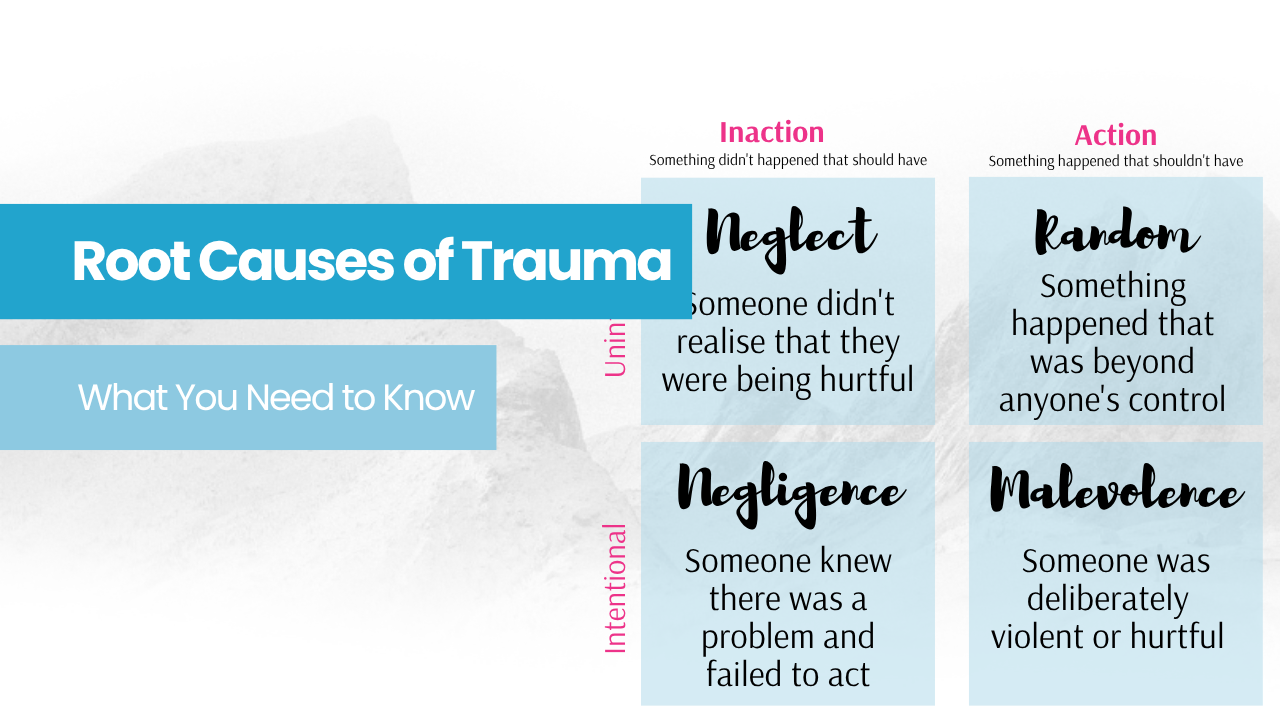
The Root Causes of Trauma Matrix
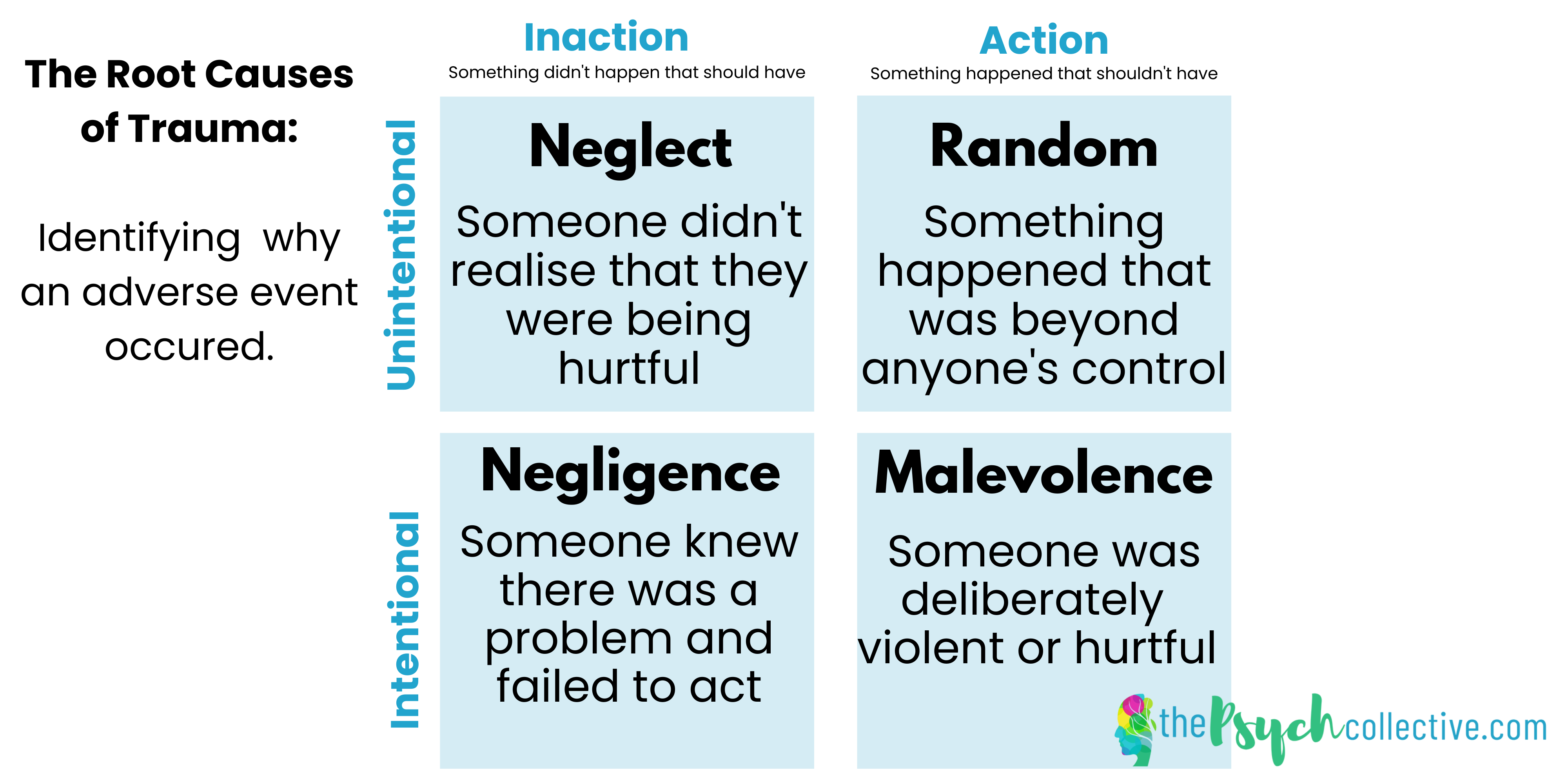
Over the years, we've developed a simple matrix that helps people understand the different ways a traumatic event can occur. Rather than assuming every trauma has a single cause, we encourage people to consider all contributing factors.
Most traumatic events are multimodal. In other words, there are usually multiple root causes that contributed to the event.
The matrix looks at two questions:
-
Did something happen that shouldn't have happened, or did something fail to happen that should have?
-
Was it intentional or unintentional?
When we combine these, we end up with four possible root causes.
Neglect
Neglect occurs when something that should have happened didn't, and the person didn't realise they were causing harm.
There was no malicious intent. Someone simply didn't know what they should have done or failed to recognise that their actions—or lack of action—would hurt someone else.
This is often seen in relationships, parenting, workplaces and healthcare settings where people genuinely believe they were doing the right thing, or simply didn't recognise the impact of their behaviour.
Negligence
Negligence is different.
Negligence occurs when someone knew there was a problem and failed to act anyway.
The important difference is awareness.
The person recognised the risk but chose not to take the necessary action to prevent harm.
This might involve knowingly ignoring safety procedures, failing to intervene when someone needed help, or taking unnecessary risks that placed others in danger.
Randomness
Sometimes terrible things happen because they are simply beyond anyone's control.
Natural disasters, accidents and unpredictable events can all fall into this category.
This can actually be one of the hardest concepts for people to accept because our brains desperately want an explanation.
We want someone to blame.
Sometimes there isn't.
Sometimes people were simply in the wrong place at the wrong time.
Malevolence
Malevolence occurs when someone deliberately intends to cause harm.
This includes assaults, violence, abuse and other situations where another person's goal was to hurt someone else.
Understanding that someone acted with deliberate intent can sometimes help people stop searching for alternative explanations that simply aren't there.
Trauma Is Usually Multimodal
One of the biggest mistakes people make is assuming there was only one cause.
Most traumatic events involve several contributing factors.
Take the example Dr Al often uses from his time as a medical student.
He was walking home one evening when he saw five men standing ahead on the street. He recognised they looked like they might be trouble. He considered crossing the road or taking a different route, but decided against it.
Shortly afterwards, he was assaulted.
From the offenders' perspective, this was clearly malevolence. They intentionally assaulted him.
But when reflecting on the event later, Al realised there was another contributing factor.
Dr Al had been self-negligent.
He recognised the potential risk but allowed pride to influence his decision.
As he often says, the lesson wasn't that the assault was his fault. The lesson was:
"Don't let pride put you in harm's way."
Understanding that distinction helped him find meaning in the experience without excusing the offenders' behaviour.
Sometimes There Is No Lesson About You
Jess often uses a completely different example.
At 34 weeks pregnant, she was stopped at a Give Way sign when another driver failed to stop and rear-ended her vehicle.
Fortunately, both she and the baby were okay.
When we apply the matrix, the other driver's behaviour fits the neglect category. He failed to stop, but there was no evidence that he intended to cause harm. Had he been speeding, using his phone, or driving under the influence, it might have constituted negligence because he knowingly took unnecessary risks.
For Jess, however, the experience fell into randomness.
She had stopped where she was supposed to stop.
She hadn't done anything wrong.
There was nothing she could have done differently to prevent the accident.
And sometimes that is the lesson.
Not every traumatic experience contains a hidden mistake you were supposed to avoid.
Sometimes the most important conclusion is recognising:
"It wasn't my fault."
For many people, this is incredibly powerful.
Why Understanding the Root Causes Matters
One of the reasons people become stuck after trauma is that they continue asking questions that have never been answered.
Why me?
Who was responsible?
Could I have prevented it?
Should I have done something differently?
The Root Causes Matrix doesn't remove the pain of a traumatic experience.
What it can do is help organise the event in a way that makes sense.
Once people understand the contributing factors, they're often able to identify whether there is a meaningful lesson to take forward—or whether the healthiest conclusion is that the event was simply outside of their control.
Either way, understanding the why helps many people stop endlessly searching for answers and begin integrating the experience into their life story.
That's exactly why we developed this framework.
About Our Resources