Identity
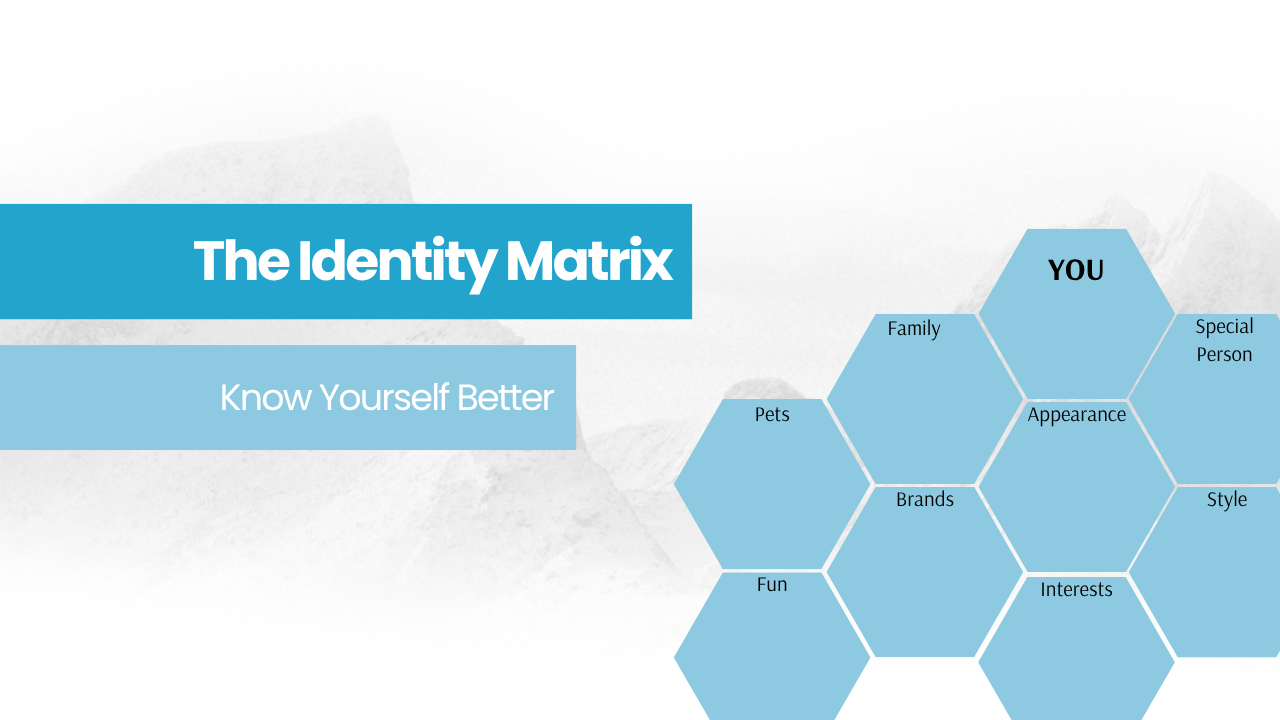
The Identity Matrix:
How to Find Yourself When Life Changes You
By Jessica O'Garr (Clinical Psychologist) and Dr Al Griskaitis (Psychiatrist)
Have you ever stopped and wondered:
Who am I?
Not your job title.
Not your relationship status.
Not your role as a parent, partner, carer or employee.
You.
It sounds like a simple question, but for many people it can be surprisingly difficult to answer.
Over the years we've worked with countless people who have said things like:
- "I don't know myself"
- "I don't know what I want anymore."
- "I used to know what I liked."
- "Everything feels different now."
- "I don't know what I want from life."
This is exactly why we developed the Identity Matrix Worksheet.
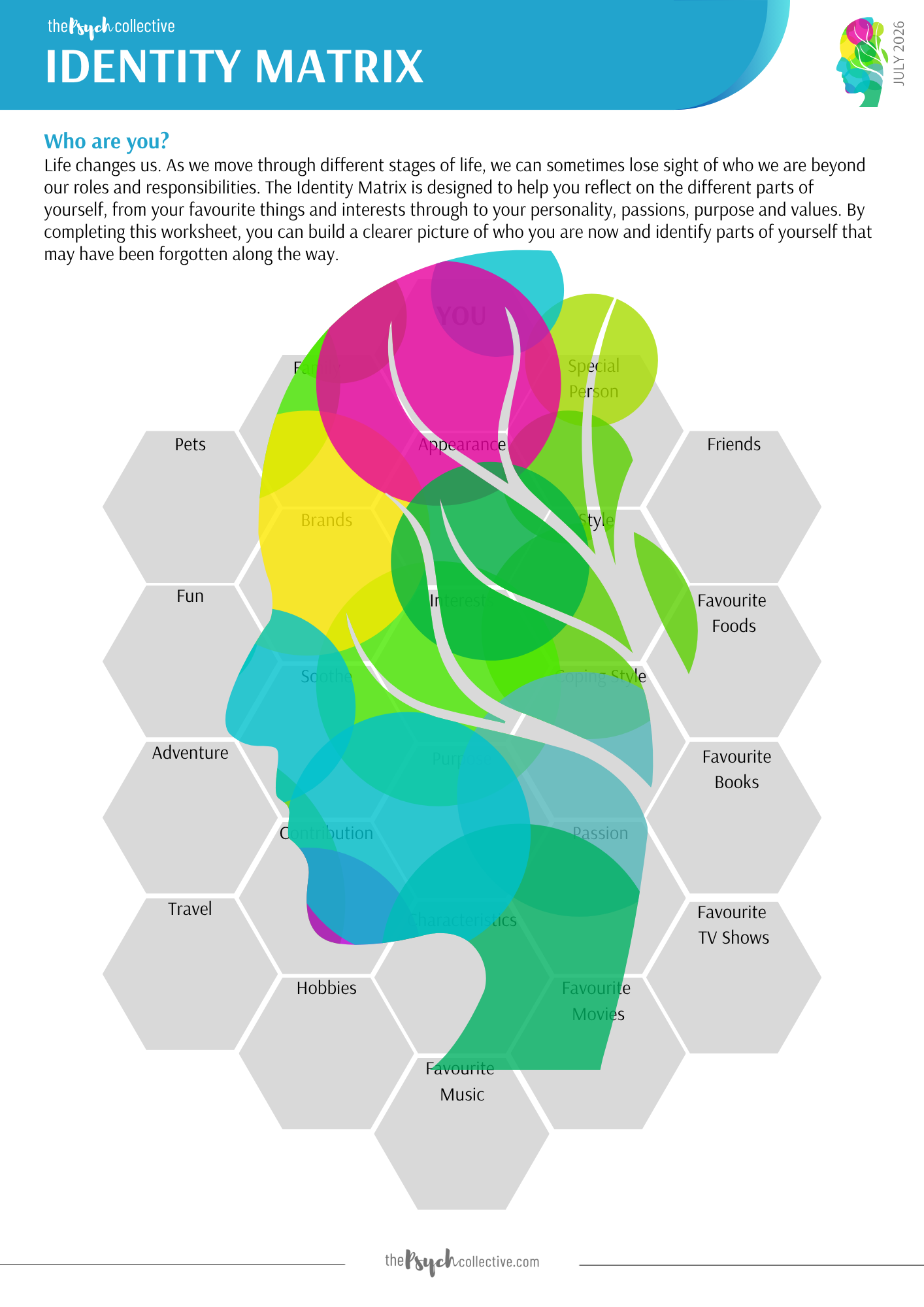
The Identity Matrix is designed to help people describe who they are by recognising that identity exists on multiple levels. Some parts are visible on the surface, while others sit much deeper beneath the surface.
By exploring these different layers, people can begin to develop a stronger, more stable sense of self.
What Is the Identity Matrix?
The Identity Matrix is a structured reflection exercise that helps people identify different facets of their identity.
It starts with some of the more obvious and visible aspects of identity:
- How we look
- How we dress
- The brands we like
- How we choose to present ourselves to the world
From there, it moves into some familiar "getting to know you" questions:
- What's your favourite movie?
- What's your favourite book?
- What's your favourite TV show?
- What's your favourite food?
- What music do you listen to?
Then it goes deeper.
The worksheet explores:
- The important people in your life
- Family
- Friends
- Pets
- Hobbies
- Interests
- Travel goals
- Adventure bucket lists
Finally, it reaches some of the deepest parts of identity:
- Characteristics
- Contribution to society
- Passion
- Purpose
The goal isn't simply to fill out a worksheet.
The goal is to build a picture of yourself that is bigger than any single role, relationship or life circumstance.
Why Do People Lose Their Sense of Self?
Life changes us.
The person you are now is not the same person you were ten years ago. In some cases, you may not even be the same person you were five years ago.
As we move through different stages of life, we adapt.
We grow.
We learn.
We survive.
Sometimes we become so focused on managing life that we stop paying attention to who we are becoming.
For some people, this happens gradually.
For others, it happens suddenly after a major life transition.
Common examples include:
- Becoming a parent
- Children leaving home
- Starting a new career
- Finishing a career
- Retirement
- Significant illness
- Relationship breakdown
- Recovery from trauma
- Military discharge
- Medical retirement
- Moving to a new location
These transitions often force us to ask:
Who am I now?
The Story Behind the Identity Matrix
Whenever I give this worksheet to patients, I usually share the story of how it came about.
The worksheet was born out of my own identity crisis.
In 2019, I found myself in a major period of transition.
I had finished university in 2013.
Within a five-year period I had:
- Got married
- Bought a house
- Had two children
- Built my career as a Clinical Psychologist
Life was busy.
Really busy.
Then something changed.
My youngest child finally started sleeping through the night.
For the first time in years, I felt like I had my head above water.
And then I had a bit of an existential crisis.
I remember thinking:
"I'm a mum. I'm a Clinical Psychologist. I'm a wife. I'm a homeowner. But where the hell did Jess go?"
That question hit me harder than I expected.
I realised I knew all of my roles.
But I wasn't sure I knew myself anymore.
My Failed Art Therapy Experiment
My first idea was to create an art therapy exercise.
I thought I would sit down with a piece of paper and draw all the different parts of my identity.
It sounded great in theory.
Then I sat down with a pencil.
And immediately had the startling realisation:
"I can't draw."
That quickly ended the art therapy experiment.
So instead, it became a written exercise.
The first version of what would eventually become the Identity Matrix.
Rediscovering Forgotten Parts of Myself
What surprised me most was how long the exercise took.
I spent almost three weeks working through it.
Not because it was difficult.
Because many of the answers had simply been forgotten.
Years of building a family and career had pushed certain parts of myself into the background.
Through the process, I remembered things I hadn't thought about for years.
For example, I rediscovered how much I enjoy piano music.
That sounds like a small thing.
But it changed daily life.
Instead of listening exclusively to The Wiggles while folding laundry, we started listening to Ludovico Einaudi and other piano music.
I also remembered how much I loved jigsaw puzzles.
My children had finally reached an age where they weren't putting every small object into their mouths.
That meant I could actually get a puzzle out again.
Small discoveries.
But meaningful ones.
Because they reminded me of parts of myself that still existed.
They had simply been forgotten.
How the Identity Matrix Helped Create The Psych Collective
What happened next was something I never anticipated.
This process of self-reflection led to a number of conversations with Dr Al Griskaitis.
We started talking about purpose.
Contribution.
Passion.
What we wanted to build.
What we thought was missing in mental health.
Those conversations ultimately led to the creation of The Psych Collective in late 2019.
In many ways, the Identity Matrix wasn't just an exercise in self-discovery.
It became a catalyst for building something new.
Identity Is Not Fixed
One of the most important messages I try to give patients is this:
Identity is not fixed.
It changes.
It evolves.
It adapts.
You are not supposed to be exactly the same person you were at 18.
Or 25.
Or 45.
Life experiences shape us.
The challenge is making sure we stay connected to ourselves during that process.
This is why I often describe the Identity Matrix as a living document.
It should change over time.
In fact, if it never changes, that's probably a problem.
As you grow, your answers should evolve too.
Identity Problems in Borderline Personality Disorder
One of the groups I frequently recommend this worksheet to is people with Borderline Personality Disorder (BPD).
A fluctuating sense of self is a common feature of BPD.
People often describe feeling as though their identity changes depending on:
- Who they are with
- How they feel
- What is happening around them
They may struggle to answer questions such as:
- What do I actually like?
- What matters to me?
- What kind of person am I?
- What do I want from life?
The Identity Matrix helps by creating a structured snapshot of identity across multiple domains.
Rather than defining themselves by a single mood, relationship or crisis, people begin to see a much broader picture of who they are.
Identity Problems After Trauma
This worksheet is also useful for people who have experienced trauma.
For some individuals, particularly those with significant childhood trauma, there was never much opportunity to develop a strong sense of self in the first place.
When you're stuck in survival mode, your focus is on getting through the day.
You aren't usually asking:
- What are my passions?
- What is my purpose?
- What hobbies do I enjoy?
You're trying to stay safe.
As a result, many people reach adulthood without ever fully exploring who they are beyond survival.
Others develop a strong identity but feel as though trauma has taken it away.
Occupational Trauma and the Loss of Identity
This is something we commonly see in emergency services workers, military personnel and veterans.
Imagine someone who has worked in an emergency services role for 30 years.
Their job isn't just what they do.
It becomes who they are.
The uniform.
The culture.
The skills.
The camaraderie.
The purpose.
Then PTSD develops.
Eventually they are medically retired.
Suddenly, the role that has defined them for decades disappears.
Many people describe this experience as:
"I've lost my sense of self."
The Identity Matrix helps people recognise that they are far more than their job title.
It helps them identify parts of their identity that existed before the career and can continue long after the career ends.
Using the Identity Matrix for Goal Setting
One variation of this exercise that many patients find helpful is completing two versions.
The first version captures:
Who am I now?
The second version captures:
Who do I want to become?
This transforms the Identity Matrix into a goal-setting tool.
Instead of simply describing your current identity, you begin identifying:
- New hobbies to explore
- New experiences to have
- New skills to learn
- New contributions to make
- New passions to pursue
The gap between the two versions often reveals some surprisingly meaningful goals.
Combining the Identity Matrix with the Big Five Personality Traits
We often recommend using the Identity Matrix alongside our Big Five Personality Traits worksheet.
The Identity Matrix explores:
- Preferences
- Interests
- Values
- Purpose
- Relationships
The Big Five explores:
- Openness
- Conscientiousness
- Extraversion
- Agreeableness
- Neuroticism
Together, these exercises help people develop a more grounded understanding of who they are.
They can identify strengths.
Recognise blind spots.
Reconnect with forgotten parts of themselves.
And start building a life that feels more authentic.
Final Thoughts
One of the biggest lessons I've learned from this exercise is that losing your sense of self is surprisingly common.
It doesn't mean something is wrong with you.
It often means you've been busy surviving, adapting or growing.
Sometimes we become so focused on our responsibilities that we forget to check in with ourselves.
The Identity Matrix is an opportunity to pause and ask:
- Who am I?
- What matters to me?
- What do I enjoy?
- What am I passionate about?
- What kind of contribution do I want to make?
Because when you step back and look at the whole picture, you begin to realise something important:
You are greater than the sum of your parts.
And sometimes finding yourself isn't about becoming someone new.
It's about remembering who you were all along.
Download the Identity Matrix worksheet
Check out this resource and start mapping out your identity. Click HERE.
About Our Resources